


Defence Finance Monitor applies a top–down method that traces how NATO, EU and allied strategic priorities are translated into regulations, funding lines and procurement programmes, and then into demand for specific capabilities, technologies and companies. We use official doctrine as the organising frame to identify where strategic relevance is being institutionally defined and where it is materialising in concrete budgets, acquisition pathways and industrial capacity.
Our working assumption is that what becomes structurally relevant in NATO/EU strategy tends, over time, to become relevant also from a financial and industrial point of view. In the European context, this includes the progressive operationalisation of strategic autonomy: the effort to reduce critical dependencies, secure supply chains, strengthen the European defence technological and industrial base, and align regulatory, financial and procurement instruments with long-term security objectives. On this basis, DFM operates as a decision-support tool: it benchmarks investment and industrial choices against institutional demand, clarifies which capabilities are rising on the spending agenda, and maps the funding instruments, eligibility constraints and supply-chain factors that shape real-world feasibility across investors, industry, public authorities and research organisations.
Defence Finance Monitor rests on a single analytical premise: within the Euro-Atlantic security architecture, strategic doctrine precedes regulation and capability planning, regulation precedes budgets, and budgets shape markets.
EU Non-Member Access to SAFE Through Security and Defence Partnerships
The European Union’s SAFE instrument is no longer only a mechanism for financing common defence procurement among Member States. It is becoming the legal and industrial bridge through which selected non-EU partners may obtain structured access to parts of the European defence procurement ecosystem. The EU-Canada SAFE agreement is the first decisive precedent: it shows that a Security and Defence Partnership can evolve into a negotiated, paid and compliance-heavy access framework for third-country companies and products. This development matters because it changes the commercial meaning of EU defence cooperation. Market access will increasingly depend not only on political alignment, but on legal eligibility, executive management location, control structures, component origin, security-of-supply commitments, export-licensing discipline and the ability to meet EU-defined industrial-sovereignty requirements.
The report analyses this emerging architecture through SAFE, the EU-Canada agreement, and selected EU Security and Defence Partnerships with the United Kingdom, Japan, the Republic of Korea and Norway. It first explains the legal bridge created by Regulation (EU) 2025/1106, then examines Canada as the first non-European SAFE precedent. It then compares the UK, Japan and Korea as partners that have crossed the political threshold but have not yet reached Canada-style SAFE access. Norway is treated as a distinct EEA-EFTA model rather than as a generic third-country precedent. The final sections assess what this means for defence companies, banks, M&A advisers, law firms and sovereign investors seeking to understand which non-EU actors can convert partnership status into legally robust procurement eligibility and bankable industrial capacity.
Triple-Layer Foreign Investment Compliance for Defence M&A
European defence M&A is no longer governed by a single regulatory question. A cross-border transaction involving defence, dual-use, cyber, space, AI, quantum, semiconductors or critical infrastructure may now trigger several distinct forms of state review at the same time. The Foreign Subsidies Regulation examines whether non-EU financial support distorts the internal market; the EU FDI framework and national screening regimes assess risks to security and public order; and the emerging outbound investment monitoring framework introduces a further layer around technology leakage, know-how transfer and strategic dependency. The result is a new transaction environment in which capital origin, governance rights, access to sensitive data, technology transfer and public-sector financing can matter as much as price, industrial fit or antitrust clearance.
The report is structured around the three principal layers of this new compliance architecture. It first analyses the Foreign Subsidies Regulation as a Commission-led tool for scrutinising foreign financial contributions in mergers, acquisitions and public procurement. It then examines the reform of the EU FDI Screening Regulation and selected national regimes for which primary-source coverage is developed in this report, namely Italy, France, Germany and the Netherlands. It also addresses Recommendation (EU) 2025/63 on outbound-investment monitoring and draws limited comparative observations on the United States, Japan and South Korea where relevant to transaction planning. The final sections translate the regulatory framework into transaction practice, assessing implications for deal timing, due diligence, sovereign wealth funds, private equity, venture capital, law firms, M&A advisers and the future of European defence-industrial consolidation.
The EIB Weapons and Ammunition Exclusion and the Fracturing of Europe’s Defence Capital Pool
The European Investment Bank Group has moved decisively into security and defence finance, expanding its eligibility perimeter to cover military infrastructure, cyber, space, sensors, radar, mobility, drones and other strategic technologies. Yet it continues to exclude “weapons and ammunition” from its financing framework. This distinction creates a structural fracture inside Europe’s public defence capital pool: companies operating around the defence ecosystem can increasingly access supranational finance, while pure-play ammunition, explosives, propellants and weapons producers remain dependent on alternative channels. The result is not an absence of capital, but a segmented financing landscape in which eligibility, use-of-proceeds discipline, procurement visibility and national promotional-bank mandates determine who can fund capacity expansion, at what cost, and under which constraints.
The report examines this fracture through the interaction of EIB policy, EU defence instruments and market-based financing channels. It first reconstructs the EIB’s defence-financing expansion and the legal meaning of the weapons-and-ammunition exclusion, then compares that exclusion with SAFE, EDIP and EIF instruments. It then analyses the companies and industrial segments most exposed to the gap, including munitions, propellants, explosives and weapons-system producers, before assessing the role of national promotional banks, procurement-backed finance, private credit, bond issuance, public equity and M&A. The final sections draw out the implications for defence primes, pure-play munitions producers, DCM desks, private-credit funds, policymakers, regulatory counsel and institutional investors.
DFM Intelligence · Platform Capability
Problems DFM Intelligence Now Solves
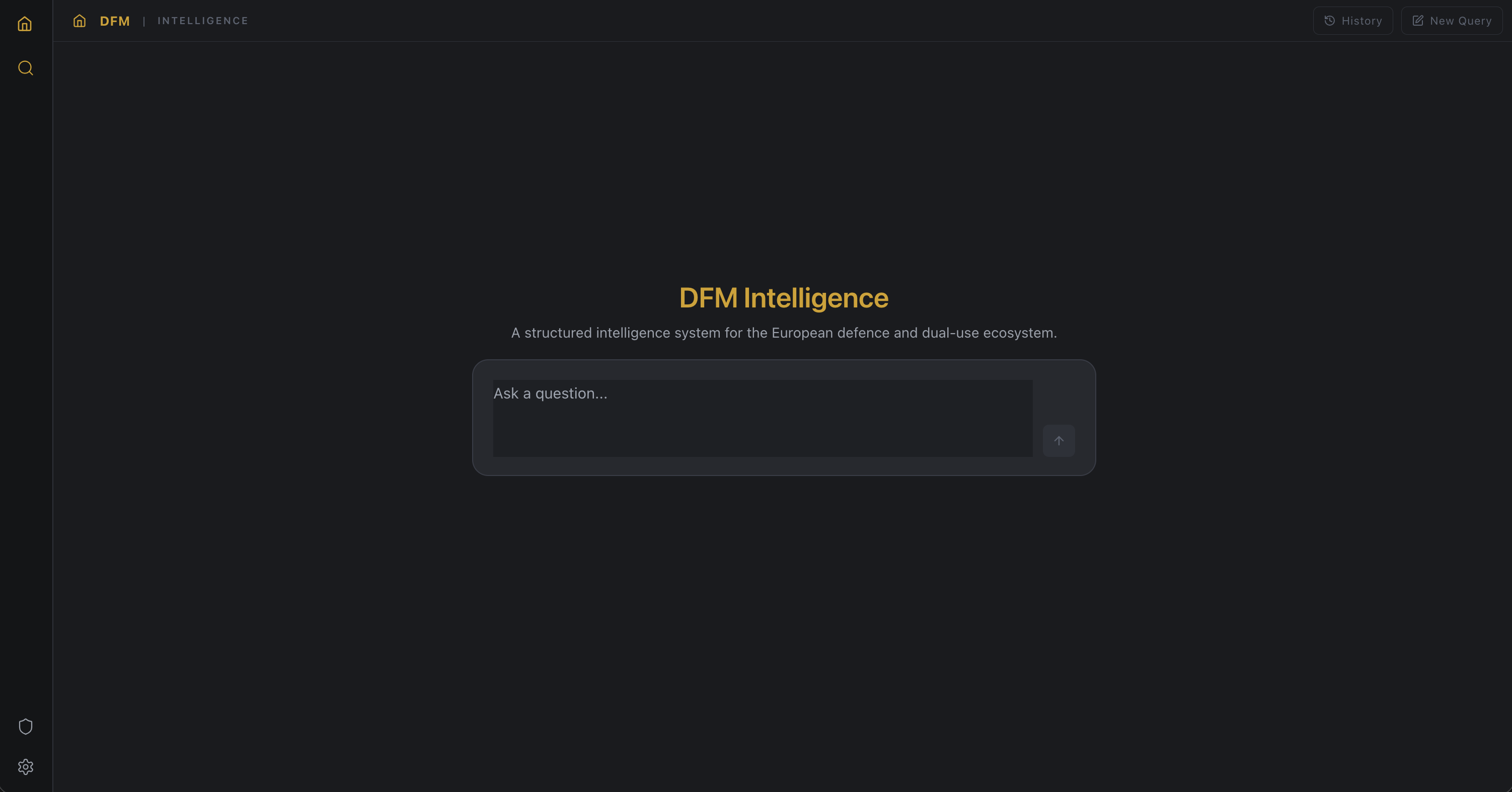
Defence Finance Monitor is an intelligence platform for the European defence-industrial base. It runs on a verified database of more than 2,000 European defence and dual-use enterprises, each mapped against the strategic priorities defined by EU and NATO policy, and maintained as the perimeter evolves through procurement awards, ownership changes, regulatory notifications and programme participation.
A single structured query resolves work that has traditionally required extended analyst effort: identifying the Tier-2 and Tier-3 suppliers behind a prime contractor, determining which firms are exposed to EDIP origin rules, Golden Power notifications or critical-raw-material dependencies, reconstructing contract awards under EDF, EDIRPA and ASAP, or tracing the ownership chain behind a strategic asset. Every statement carries a stated confidence level and a citation to the official institutional source it rests on. Where a fact cannot be verified against source, it is marked as such rather than asserted.
For a law firm, a corporate-development team, a sovereign fund or a procurement office, the consequence is direct: institutional research that once defined the cost and timing of a deliverable now defines where the analysis begins.
DFM Intelligence is reserved for subscribers to the DFM annual programme.
For further information about DFM Intelligence, access conditions or payment by bank transfer, please contact: mastrolia@stroncature.com