


Defence Finance Monitor applies a top–down method that traces how NATO, EU and allied strategic priorities are translated into regulations, funding lines and procurement programmes, and then into demand for specific capabilities, technologies and companies. We use official doctrine as the organising frame to identify where strategic relevance is being institutionally defined and where it is materialising in concrete budgets, acquisition pathways and industrial capacity.
Our working assumption is that what becomes structurally relevant in NATO/EU strategy tends, over time, to become relevant also from a financial and industrial point of view. In the European context, this includes the progressive operationalisation of strategic autonomy: the effort to reduce critical dependencies, secure supply chains, strengthen the European defence technological and industrial base, and align regulatory, financial and procurement instruments with long-term security objectives. On this basis, DFM operates as a decision-support tool: it benchmarks investment and industrial choices against institutional demand, clarifies which capabilities are rising on the spending agenda, and maps the funding instruments, eligibility constraints and supply-chain factors that shape real-world feasibility across investors, industry, public authorities and research organisations.
Defence Finance Monitor rests on a single analytical premise: within the Euro-Atlantic security architecture, strategic doctrine precedes regulation and capability planning, regulation precedes budgets, and budgets shape markets.
The irresistible attraction
A single idea has captured the defence imagination on both sides of the world: that a new generation of cheap, rapidly producible, seemingly revolutionary systems — drones, autonomous craft, loitering and coastal missiles — has overturned the old economy of force. In Europe the conviction was forged in Ukraine, where uncrewed surface vessels drove a far larger Russian fleet from the western Black Sea, and where first-person-view drones turned a few hundred dollars into a destroyed armoured vehicle; it is now capitalised by a defence-technology boom that has minted billion-dollar start-ups on the promise of software-defined, attritable mass. In Asia the same turn is driven by fiscal strain and by doubt about a distant guarantor, channelling constrained budgets toward the cheapest available path to a credible threat. The enthusiasm is understandable, because the cheap weapon delivers something real. The question this article poses is whether it is the right path — and the answer, drawn from a pattern that recurs across more than a century of military history, is that low-cost innovation is a first step that is rarely the best one. It can buy interdiction, denial, and the power to make an adversary’s intrusion ruinous. What it cannot buy is the achievement of a strategic objective: the control of territory, the patrolling of seas and routes, the command of a contested space. For that, a state still needs the large and expensive systems the cheap weapon was supposed to render obsolete.
The Double Spur
For more than a decade Asian defence spending told a story that was easy to read. Budgets rose, year on year, in a long arithmetic of unease whose cause seemed self-evident: a rising China, neighbours who declined to be left defenceless in its shadow, and an American umbrella that one could argue about but not seriously doubt. The numbers were large, the trend was monotone, and the interpretation almost wrote itself. The figures for 2026 are larger still, and on the surface they confirm the old narrative. Yet beneath the continuity something has changed that no aggregate can capture. The region is no longer arming only against a threat. It is arming, increasingly, against a doubt — and the doubt is not about China. When the states of a security order begin to insure themselves against their own guarantor, the question worth asking is no longer how much they will spend, but what their spending now means.
The AGILE Eligibility Regime
The significance of the Programme for agile and rapid defence innovation (AGILE) lies not in its budget but in its eligibility regime. The envelope is modest — €115 million for a single pilot year, redeployed from existing defence and space programmes — and is easily read as marginal against national procurement budgets. The operative content of the Regulation is elsewhere: in the conditions of establishment, control, asset location and ownership under which a company may receive fast-track EU defence funding, and in the narrow, conditional terms on which a company not established in the Union may participate at all. These provisions decide who is inside the European defence-funding perimeter and who is outside it, and they do so in binding legal text. Because the European Commission has positioned the pilot as a legal testbed for the post-2027 European Competitiveness Fund, the eligibility architecture now under negotiation is unlikely to remain confined to a one-year instrument; it is the working draft of a substantially larger and more consequential funding framework. The question this report examines is therefore not the scale of the programme but the design and durability of the rules of access it establishes.
DFM Intelligence · Platform Capability
Problems DFM Intelligence Now Solves
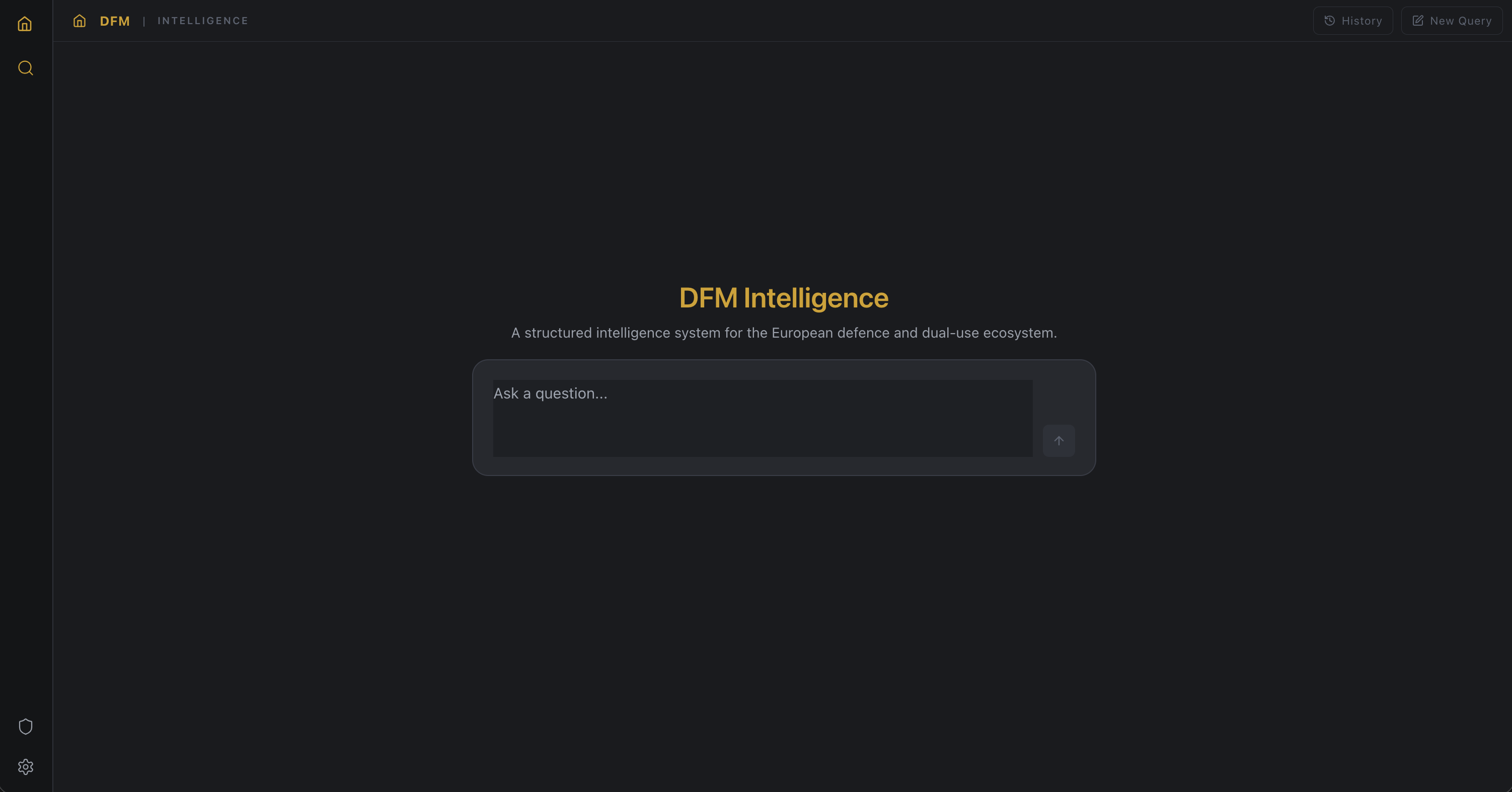
Defence Finance Monitor is an intelligence platform for the European defence-industrial base. It runs on a verified database of more than 2,000 European defence and dual-use enterprises, each mapped against the strategic priorities defined by EU and NATO policy, and maintained as the perimeter evolves through procurement awards, ownership changes, regulatory notifications and programme participation.
A single structured query resolves work that has traditionally required extended analyst effort: identifying the Tier-2 and Tier-3 suppliers behind a prime contractor, determining which firms are exposed to EDIP origin rules, Golden Power notifications or critical-raw-material dependencies, reconstructing contract awards under EDF, EDIRPA and ASAP, or tracing the ownership chain behind a strategic asset. Every statement carries a stated confidence level and a citation to the official institutional source it rests on. Where a fact cannot be verified against source, it is marked as such rather than asserted.
For a law firm, a corporate-development team, a sovereign fund or a procurement office, the consequence is direct: institutional research that once defined the cost and timing of a deliverable now defines where the analysis begins.
DFM Intelligence is reserved for subscribers to the DFM annual programme.
For further information about DFM Intelligence, access conditions or payment by bank transfer, please contact: mastrolia@stroncature.com