

Defence Finance Monitor applies a top–down method that traces how NATO, EU and allied strategic priorities are translated into regulations, funding lines and procurement programmes, and then into demand for specific capabilities, technologies and companies. We use official doctrine as the organising frame to identify where strategic relevance is being institutionally defined and where it is materialising in concrete budgets, acquisition pathways and industrial capacity.
Our working assumption is that what becomes structurally relevant in NATO/EU strategy tends, over time, to become relevant also from a financial and industrial point of view. In the European context, this includes the progressive operationalisation of strategic autonomy: the effort to reduce critical dependencies, secure supply chains, strengthen the European defence technological and industrial base, and align regulatory, financial and procurement instruments with long-term security objectives. On this basis, DFM operates as a decision-support tool: it benchmarks investment and industrial choices against institutional demand, clarifies which capabilities are rising on the spending agenda, and maps the funding instruments, eligibility constraints and supply-chain factors that shape real-world feasibility across investors, industry, public authorities and research organisations.
Defence Finance Monitor rests on a single analytical premise: within the Euro-Atlantic security architecture, strategic doctrine precedes regulation and capability planning, regulation precedes budgets, and budgets shape markets.
KNDS and the Sovereign IPO
KNDS N.V. is preparing a dual Frankfurt–Paris listing in 2026 under a structure that inverts the privatisation model: the state does not exit, it enters or reinforces. The industrial case is established — €4.4 billion of 2025 revenue, an order backlog of €33.1 billion, EBIT of €661 million, a 15.0% return on sales. The market-structure case is not. A reported 40/40 Franco-German shareholding leaving roughly 20% to the market, an indicative €15–20 billion valuation band, and a SpaceX listing competing for global allocation in the same window, are market-source estimates, not company guidance. The institutional question is therefore narrow and demanding: at what price will minority capital sit alongside two sovereign shareholders, with a thin float, no controlling rights, and without the cash-flow disclosure such a premium normally requires? The report sets out the three discounts a disciplined valuation must explicitly price in, tests the implied multiples against verified figures, walks the DAX and CAC eligibility methodologies, and traces the regulatory frames that will shape the post-IPO register.
The full assessment is reserved for DFM paid subscribers.
EDIP Becomes Operational
The European Defence Industry Programme has stopped being a legislative ambition. Regulation (EU) 2025/2643 has been in force since the end of December 2025, the 2026–2027 work programme was adopted on 30 March 2026, and the first calls became visible on the EU Funding & Tenders Portal on 31 March 2026. The analytical question is therefore no longer whether EDIP exists, but whether its €1.5 billion envelope across two years can be translated into measurable production capacity, cross-border procurement and Ukrainian industrial integration within a short operating window. The report reconciles the headline budget in full — including the recurring claim of a missing €100 million — maps each euro to a specific call topic, traces the financing topology that pure-play missile and ammunition manufacturers must now navigate given the European Investment Bank’s continued exclusion of weapons and ammunition, and positions EDIP against its predecessors ASAP and EDIRPA to show what is structurally new and what remains insufficient at scale.
The full work programme map and the financing topology are reserved for DFM paid subscribers.
The Capital Sovereignty Problem in European Defence-Tech
Is a defence-tech company headquartered in Munich, with European founders and a reported 80% European cap-table, sovereign — when its $1.2 billion growth round is led from the United States? European defence-tech has crossed a structural threshold: a record $8.7 billion raised in 2025 according to Dealroom and the NATO Innovation Fund, with US investors estimated at 40 to 50% of the capital, concentrated in precisely the late-stage cheques where valuation, governance and exit are formed. Helsing makes the pattern visible; Quantum Systems shows the counter-pattern; Anduril sets the benchmark. The report builds the analytical discipline required to read this market correctly, examines the European public architecture and its growth-stage limits, tests SAFE and EDIP against the demand-side question, and reads the revised FDI screening framework against the risk of deterring the very capital Europe needs. The conclusion refuses two opposite errors: inferring European sovereignty from European headquarters, and inferring American control from American capital participation.
The full sovereignty framework and the conditions under which US capital is compatible with European autonomy are reserved for DFM paid subscribers.
DFM Intelligence · Platform Capability
Problems DFM Intelligence Now Solves
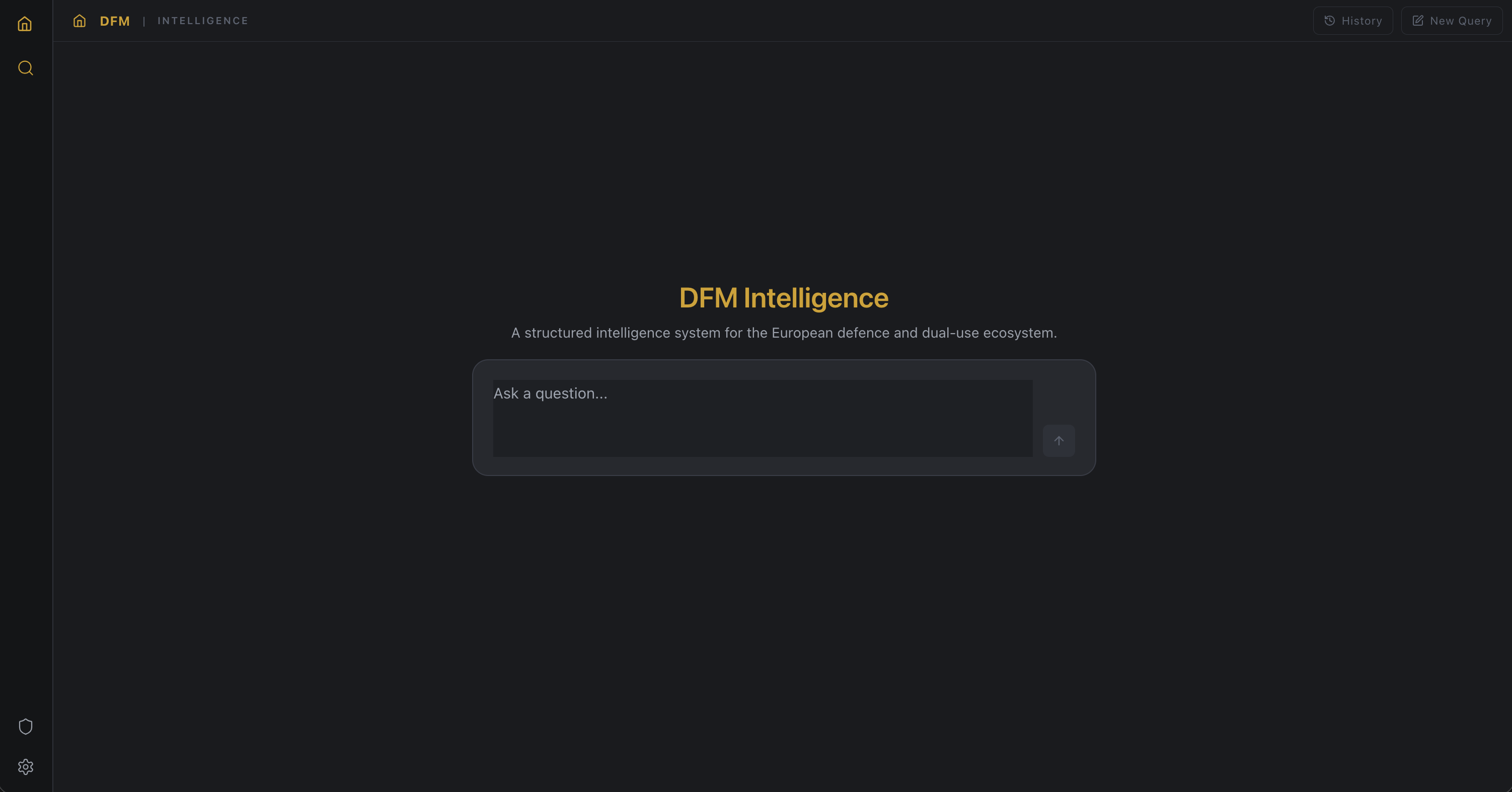
Defence Finance Monitor is an intelligence platform for the European defence-industrial base. It runs on a verified database of more than 2,000 European defence and dual-use enterprises, each mapped against the strategic priorities defined by EU and NATO policy, and maintained as the perimeter evolves through procurement awards, ownership changes, regulatory notifications and programme participation.
A single structured query resolves work that has traditionally required extended analyst effort: identifying the Tier-2 and Tier-3 suppliers behind a prime contractor, determining which firms are exposed to EDIP origin rules, Golden Power notifications or critical-raw-material dependencies, reconstructing contract awards under EDF, EDIRPA and ASAP, or tracing the ownership chain behind a strategic asset. Every statement carries a stated confidence level and a citation to the official institutional source it rests on. Where a fact cannot be verified against source, it is marked as such rather than asserted.
For a law firm, a corporate-development team, a sovereign fund or a procurement office, the consequence is direct: institutional research that once defined the cost and timing of a deliverable now defines where the analysis begins.
DFM Intelligence is reserved for subscribers to the DFM annual programme.
For further information about DFM Intelligence, access conditions or payment by bank transfer, please contact: mastrolia@stroncature.com