

Defence Finance Monitor applies a top–down method that traces how NATO, EU and allied strategic priorities are translated into regulations, funding lines and procurement programmes, and then into demand for specific capabilities, technologies and companies. We use official doctrine as the organising frame to identify where strategic relevance is being institutionally defined and where it is materialising in concrete budgets, acquisition pathways and industrial capacity.
Our working assumption is that what becomes structurally relevant in NATO/EU strategy tends, over time, to become relevant also from a financial and industrial point of view. In the European context, this includes the progressive operationalisation of strategic autonomy: the effort to reduce critical dependencies, secure supply chains, strengthen the European defence technological and industrial base, and align regulatory, financial and procurement instruments with long-term security objectives. On this basis, DFM operates as a decision-support tool: it benchmarks investment and industrial choices against institutional demand, clarifies which capabilities are rising on the spending agenda, and maps the funding instruments, eligibility constraints and supply-chain factors that shape real-world feasibility across investors, industry, public authorities and research organisations.
Defence Finance Monitor rests on a single analytical premise: within the Euro-Atlantic security architecture, strategic doctrine precedes regulation and capability planning, regulation precedes budgets, and budgets shape markets.
From Capability Target to Order Book
For three decades, European air and missile defence was a residual capability, sized for expeditionary wars rather than the defence of national territory. Russia’s invasion of Ukraine ended that assumption in a single season: saturation attacks by missiles, loitering munitions and cheap drones proved that the contested medium in a European war is the air above the homeland. Integrated air and missile defence is now ranked first in both the NATO Capability Targets agreed at The Hague and the EU’s Readiness 2030 priorities, and that ranking is already reshaping where demand, and capital, flow. The decisive question is no longer whether the priority is real, but how far down the supply chain its consequences reach.
This report traces a single chain from end to end. It begins with the strategic problem as public buyers have defined it, follows that problem through the institutional instruments that codify it — the NATO targets, the European Air Shield flagship, the EDIP and SAFE financing rules — and decomposes the capability stack those instruments demand, from sensing to command and control to tiered effectors. It then identifies the prime and tier-1 enterprises the institutional filters elevate, and devotes a dedicated chapter to the tier-2 and tier-3 layer where the priority creates its most concentrated and least substitutable value, before closing with the capital movement now visible in record order books, equity valuations and fund flows. The aim throughout is foresight: to read the institutions before the order books, and the order books before the market.
Advanced Protection Systems and SKYctrl: Poland’s C-UAS Stack Between Sovereign Radar, PGZ Integration and Middle Eastern Exportability
The rapid expansion of uncrewed aerial threats has turned counter-UAS capability from a specialised force-protection requirement into a central component of air defence, critical infrastructure security and battlefield survivability. Poland’s response to this shift is especially significant. Positioned on NATO’s eastern flank and shaped by the operational lessons of Ukraine, Warsaw is seeking systems that can detect, classify, track and neutralise small drones within a layered national defence architecture. Advanced Protection Systems S.A. sits at the centre of this transition. Its SKYctrl system, FIELDctrl radar family and command-and-control layer offer a domestically developed, ITAR-free technology stack that allows Poland to combine sovereign capability with allied industrial integration.
This report analyses APS as more than a supplier of anti-drone equipment. It examines the company’s technology stack, including SKYctrl, FIELDctrl and CyView/SanView C2; its role within the PGZ-Kongsberg SAN C-UAS programme; the industrial implications of embedding a Polish specialist inside a wider NATO-compatible architecture; and the company’s export prospects in the Middle East and GCC infrastructure-security market. The report also benchmarks APS against larger European C-UAS architectures, including Rheinmetall Skymaster/Skynex and Leonardo ORCUS/Falcon Shield, to assess whether APS can scale from a national specialist into a durable European defence-industrial node.
Tactical Communications and the European Sovereignty Test
Tactical communications is the connective tissue of every other capability European defence has been trying to acquire since February 2022. Air-defence batteries, counter-drone networks, manoeuvre forces, intelligence-surveillance-reconnaissance constellations and multi-domain command structures all depend on a layer of secure, jam-resistant, interoperable radios that can carry voice, data, video and positioning across heterogeneous national fleets and into coalition formations. Europe already possesses a substantial industrial base in software-defined radio — Thales, Leonardo, Rohde & Schwarz, Bittium, Indra, Radmor and a wider SME archipelago — but that base has long appeared as a cluster of strong national ecosystems rather than as a fully integrated European market. The central question, therefore, is not whether European firms can design and produce credible radios; it is whether the combination of ESSOR, SCA-based portability, NATO-compatible interoperability requirements and the new European financing architecture is beginning to turn that fragmented landscape into a coherent communications domain. Three developments between November 2025 and the first week of June 2026 — the signing of the ESSOR Stage 4 contract, the publication of the EDF 2025 awards and the first SAFE disbursement to Poland — have shifted the texture of the answer.
The report is structured to keep four analytical levels separate throughout. It opens with the capability problem as the European institutional framework defines it, then reconstructs ESSOR as the convergence architecture at June 2026, with particular attention to the Stage 4 contract and its operational-deployment scope. It maps the industrial market — three primes (Thales, Leonardo, Rohde & Schwarz), three a4ESSOR consortium partners (Bittium, Indra, Radmor) and the wider SME archipelago — before turning to the demand-shaping layer through the European Defence Fund, with the ANEMOS award to Leonardo as the most consequential signal of the 2025 cycle, and then to the procurement-financing layer through SAFE, with the first €6.6 billion disbursement to Poland on 29 May 2026 as the dating event for the transition from instrument design to executed financing. The case of Radionor Communications, the Norwegian phased-array specialist that Defence Finance Monitor first profiled on 9 January 2026, is treated separately as the analytically most instructive instance of the SME layer. The report closes with the six gaps that will determine whether the architecture-layer convergence now under way translates into procurement consolidation, and with a final judgement on what mid-2026 looks like for European tactical communications.
DFM Intelligence · Platform Capability
Problems DFM Intelligence Now Solves
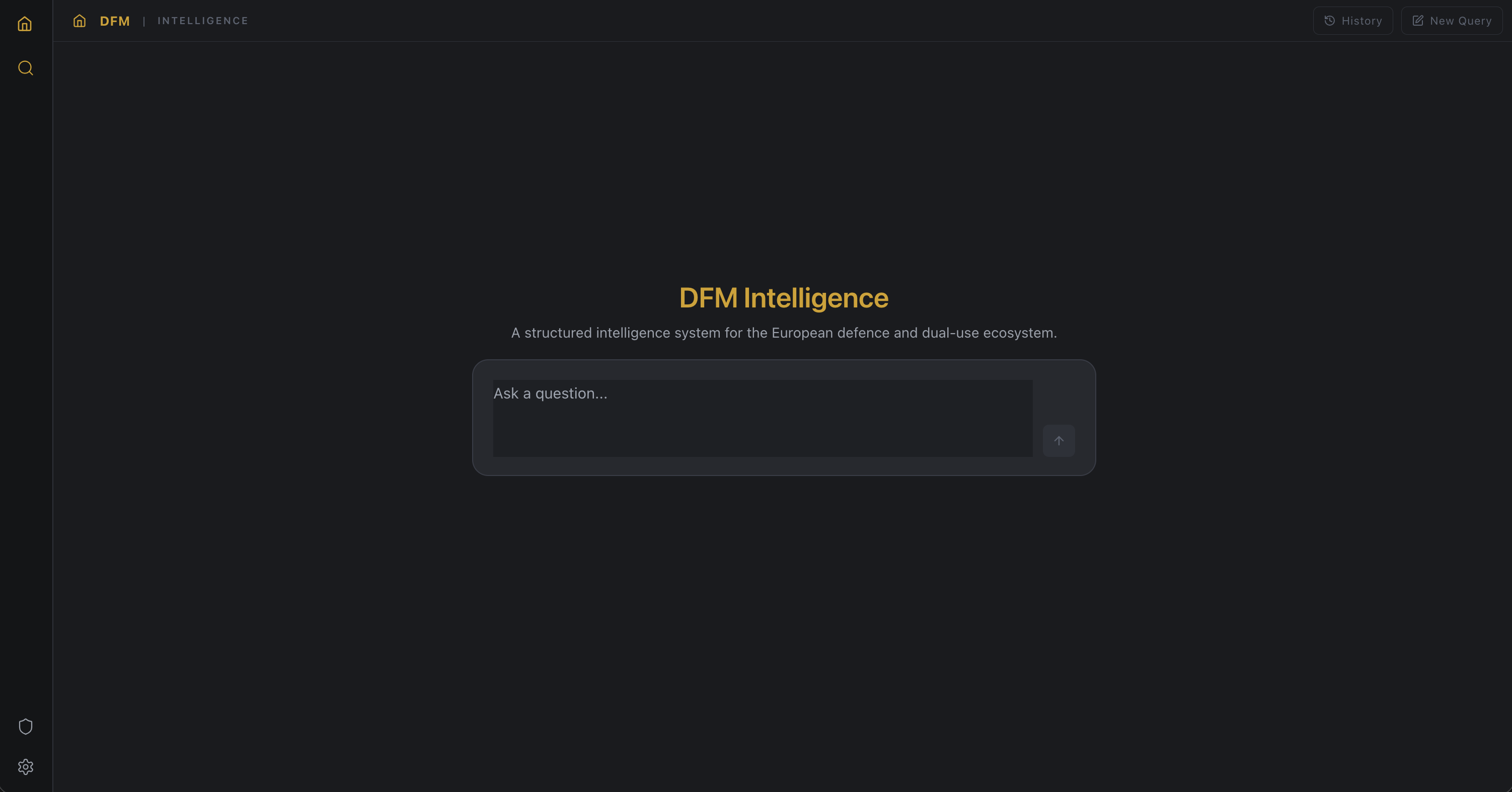
Defence Finance Monitor is not an editorial product. It is a cognitive platform built to identify the enterprises and technologies that matter against European strategic priorities and the architecture of transatlantic collective security, anchored to a verified database of more than 2,000 enterprises mapped against the European defence-industrial perimeter and extended every week with new entities as the perimeter itself evolves through procurement awards, ownership changes, regulatory notifications and programme participation. Mapping a Tier-2 or Tier-3 supplier base behind a single prime contractor, identifying which firms in a portfolio are exposed to EDIP origin rules, Golden Power notifications or critical raw materials dependencies, reconstructing contract awards under EDF, EDIRPA and ASAP, tracing ownership cascades behind a strategic asset — work that used to require weeks of analyst coordination now resolves inside a single structured query, with confidence levels marked for every statement and citations to official institutional sources. For a law firm partner, a corporate development team, a sovereign fund or a procurement office, the consequence is direct: the work that used to define the cost and timing of a deliverable now defines the starting point of an analysis. Institutional research stops being a project and becomes a capability.
DFM Intelligence is reserved for subscribers to the DFM annual programme.
For further information about DFM Intelligence, access conditions or payment by bank transfer, please contact: mastrolia@stroncature.com