

Defence Finance Monitor applies a top–down method that traces how NATO, EU and allied strategic priorities are translated into regulations, funding lines and procurement programmes, and then into demand for specific capabilities, technologies and companies. We use official doctrine as the organising frame to identify where strategic relevance is being institutionally defined and where it is materialising in concrete budgets, acquisition pathways and industrial capacity.
Our working assumption is that what becomes structurally relevant in NATO/EU strategy tends, over time, to become relevant also from a financial and industrial point of view. In the European context, this includes the progressive operationalisation of strategic autonomy: the effort to reduce critical dependencies, secure supply chains, strengthen the European defence technological and industrial base, and align regulatory, financial and procurement instruments with long-term security objectives. On this basis, DFM operates as a decision-support tool: it benchmarks investment and industrial choices against institutional demand, clarifies which capabilities are rising on the spending agenda, and maps the funding instruments, eligibility constraints and supply-chain factors that shape real-world feasibility across investors, industry, public authorities and research organisations.
Defence Finance Monitor rests on a single analytical premise: within the Euro-Atlantic security architecture, strategic doctrine precedes regulation and capability planning, regulation precedes budgets, and budgets shape markets.
EU-Ukraine Drone Alliance: Execution Beyond the Launch
The Alliance has been announced, the founding-member call has closed, and the political momentum is real — which is exactly why “has it launched?” is now the wrong question. It has, as a governance and selection process; it has not, on the public record, as a documented industrial pipeline with named members, a constituted Board, working groups, or disbursements traceable to drone projects. This analysis tracks that gap with discipline, working only from primary sources — the Readiness Roadmap, the draft Terms of Reference, the EDIP work programme, the Ukraine Support Loan legislation and the 1 April derogation decision. The finding that matters most for anyone positioning around the Alliance is counter-intuitive: its own membership gate is stricter than the funding framework surrounding it. EDIP and SAFE admit certain third-country-controlled entities under guarantees and screening; the draft Terms of Reference exclude them at the threshold. The first bottleneck, in other words, is not technology or budget — it is corporate structure, ownership, sanctions compliance and information control. A firm can qualify for the money and remain inadmissible to the room where the consortia actually form. The report sets out precisely which markers to watch through Q3 and Q4 to separate scaffolding from execution.
The difference between a member firm and a financed-but-excluded one is being decided now, in documents most market participants haven’t read line by line. The full report sets out the eligibility markers and the Q3–Q4 execution signals that tell you which side of that line you’re on.
The EU Defence Marketplace and the New Architecture of Defence Procurement
Read the Commission’s November announcement in isolation and you would expect a new EU-level procurement platform by Q4 2026. Read it against the binding texts adopted since, and the picture sharpens: the “EU Defence Marketplace” is a policy expression, not a legal category. The operative construct is the European Military Sales Catalogue under Article 37 of the EDIP Regulation, and that distinction governs everything downstream for primes, scale-ups, lenders and counsel. The catalogue is not a supranational contracting authority — actual awards stay with national authorities, procurement agents and SEAPs under Directive 2009/81/EC. What it is, and where the commercial consequence sits, is a provenance and sovereignty screen, required by law to indicate whether a manufacturer can evolve a product’s design free of third-country restriction, and whether the product sits inside the EU’s own funding architecture. The analysis insists on a separation that is easy to miss and expensive to get wrong: catalogue presence, EDIP eligibility, SAFE eligibility and national procurement eligibility are related but not identical filters. A company can be visible in the catalogue and still inadmissible to a given SAFE-financed buy, or eligible for a national procedure yet commercially invisible because it never populated the entry or evidenced its design authority. For a European subsidiary of a non-EU group, the decisive variable is no longer product quality but whether ownership, IP governance and design autonomy can be turned into auditable evidence — because on this reading the catalogue is as much a compliance gate as a sales channel.
Catalogue presence, EDIP eligibility and SAFE eligibility are three different gates, and treating them as one is the mistake that leaves eligible firms commercially invisible. The full analysis maps how they diverge — and what turns a sovereignty claim into admissible evidence.
CER, NIS2 and DORA Convergence in the Defence Supply Chain
The instinct of most defence firms is to file CER, NIS2, DORA and EDIP separately — a cyber matter, a critical-infrastructure matter, a financial-sector matter, an industrial-subsidy matter — and to conclude that little of it applies to them. That instinct is the risk. The four instruments do not add up to a single “defence supply-chain resilience law”; they create a layered perimeter defined not by the word “defence” but by functional dependence, and a Tier-2 machining business or an embedded-systems integrator can sit well inside it without ever calling itself a critical operator. This analysis works through each layer against the primary texts and then does the harder thing: it maps where they intersect — where one cloud or managed-service provider becomes a convergence node between a prime, its lenders, its insurers and a national supervisor, and where EDIP’s crisis powers (priority-rated orders, mandatory production prioritisation, permit fast-tracking) turn a financing question into an underwriting question. The judgement to take from it is that convergence is a market-structuring event, not a compliance burden: concentration risk is being re-rated simultaneously by DORA’s substitutability test, CER’s significance criteria and EDIP’s “main supplier” logic, so chokepoint suppliers will attract valuation premia and heavier obligations at once. The first-order danger is not a missed filing — it is misclassification, of the enterprise and of its dependencies, and the report is built to prevent exactly that.
The costly error here isn’t a missed filing — it’s concluding you’re out of scope when functional dependence has already pulled you in. The full report maps the four-layer perimeter and the intersection points that decide financing, underwriting and valuation.
DFM Intelligence · Platform Capability
Problems DFM Intelligence Now Solves
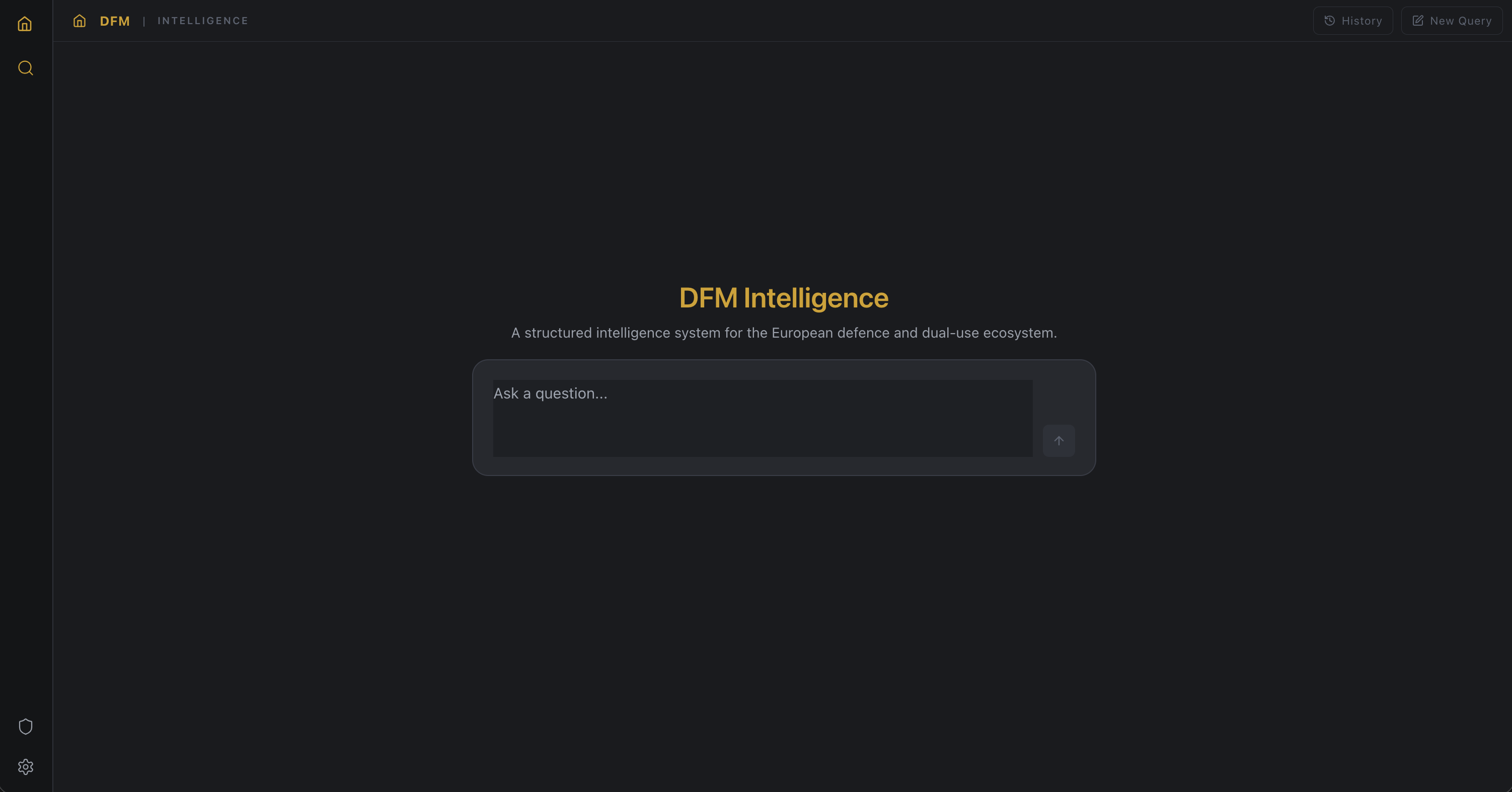
Defence Finance Monitor is not an editorial product. It is a cognitive platform built to identify the enterprises and technologies that matter against European strategic priorities and the architecture of transatlantic collective security, anchored to a verified database of more than 2,000 enterprises mapped against the European defence-industrial perimeter and extended every week with new entities as the perimeter itself evolves through procurement awards, ownership changes, regulatory notifications and programme participation. Mapping a Tier-2 or Tier-3 supplier base behind a single prime contractor, identifying which firms in a portfolio are exposed to EDIP origin rules, Golden Power notifications or critical raw materials dependencies, reconstructing contract awards under EDF, EDIRPA and ASAP, tracing ownership cascades behind a strategic asset — work that used to require weeks of analyst coordination now resolves inside a single structured query, with confidence levels marked for every statement and citations to official institutional sources. For a law firm partner, a corporate development team, a sovereign fund or a procurement office, the consequence is direct: the work that used to define the cost and timing of a deliverable now defines the starting point of an analysis. Institutional research stops being a project and becomes a capability.
DFM Intelligence is reserved for subscribers to the DFM annual programme.
For further information about DFM Intelligence, access conditions or payment by bank transfer, please contact: mastrolia@stroncature.com