

Defence Finance Monitor applies a top–down method that traces how NATO, EU and allied strategic priorities are translated into regulations, funding lines and procurement programmes, and then into demand for specific capabilities, technologies and companies. We use official doctrine as the organising frame to identify where strategic relevance is being institutionally defined and where it is materialising in concrete budgets, acquisition pathways and industrial capacity.
Our working assumption is that what becomes structurally relevant in NATO/EU strategy tends, over time, to become relevant also from a financial and industrial point of view. In the European context, this includes the progressive operationalisation of strategic autonomy: the effort to reduce critical dependencies, secure supply chains, strengthen the European defence technological and industrial base, and align regulatory, financial and procurement instruments with long-term security objectives. On this basis, DFM operates as a decision-support tool: it benchmarks investment and industrial choices against institutional demand, clarifies which capabilities are rising on the spending agenda, and maps the funding instruments, eligibility constraints and supply-chain factors that shape real-world feasibility across investors, industry, public authorities and research organisations.
Defence Finance Monitor rests on a single analytical premise: within the Euro-Atlantic security architecture, strategic doctrine precedes regulation and capability planning, regulation precedes budgets, and budgets shape markets.
Europe’s Military Space Gap
Europe’s problem is not the absence of satellites, space companies or technical competence. France, Italy, Germany, Spain, the United Kingdom and the European Union already possess significant civil, dual-use and military space assets. The strategic gap lies elsewhere: Europe does not yet have a collectively funded, operationally integrated and resilient military space architecture able to support autonomous defence operations at scale. Surveillance, reconnaissance, targeting support, secure satellite communications, missile warning, space domain awareness, resilient positioning and rapid access to space are no longer peripheral capabilities. They are the enabling layer that allows modern armed forces to see, communicate, navigate, decide and act. In these functions, European forces still rely heavily on United States military and commercial systems.
This report examines that gap as a distinct defence-industrial problem. It first defines why space has become a military operating domain and why dependence on external enablers limits European strategic agency. It then analyses the EU legal and programme framework, existing Union-level assets, national capabilities, ISR and targeting gaps, secure satellite communications, missile warning, space domain awareness, launch autonomy and the US benchmark. The report also assesses why higher European defence spending has not yet translated into coherent collective investment in military space, and what this means for industry, procurement, capital allocation and future European autonomy. The conclusion is that Europe’s military space deficit is not a simple shortage of orbital assets, but a systemic weakness in the architecture that connects satellites, ground segments, data fusion, command structures, industrial capacity and operational use.
EU-Israel Defence Industrial Relations Under Constraint
EU-Israel defence-industrial relations are not collapsing into a uniform European embargo, but they are entering a more selective and politically scrutinised phase. Since 2024, national export-licensing restrictions, litigation over arms transfers, the review of the EU-Israel Association Agreement, Commission proposals on Israel-related measures, and tighter EU defence-industrial rules have combined to reshape the conditions under which Israeli defence companies can operate in Europe. The issue is no longer whether Israeli technology remains relevant to European defence. It is whether each contract, partnership, subsidiary, component, licence and investment structure remains compatible with a denser legal, political and supply-chain environment.
The report examines this shift through four analytical layers. It first reconstructs the EU legal and political architecture, including the Association Agreement, export-control rules, EDF, SAFE, EDIP and FDI screening. It then assesses national restriction patterns in Spain, the Netherlands, Belgium, Germany, Finland, Czechia, Romania and Croatia. The third part evaluates company-level exposure for Elbit Systems, Rafael, Israel Aerospace Industries, IAI ELTA, UVision and Aeronautics, distinguishing direct market risk from Europeanised access models. The final section analyses implications for European primes, M&A advisers, law firms, private-capital investors and institutional investors, concluding that the likely trajectory is selective restriction with segmented continuity rather than comprehensive exclusion.
The European Naval Propulsion Stack
Europe’s naval rearmament cycle is creating a constraint that is less visible than shipyard capacity, missile availability or combat-system integration, but no less decisive for delivery schedules. The construction of new frigates and large surface combatants depends on a propulsion stack made of main reduction gears, couplings, shaftlines, controllable-pitch propellers, electric motors, converters, hybrid power systems, low-noise mounts and certified integration work. These components are not easily substitutable once a ship design has been frozen. Their manufacture, qualification, acoustic validation, shock resistance and naval acceptance can determine whether a programme remains on schedule or becomes structurally exposed. The central issue is whether Europe’s growing frigate pipeline is now pressing against a small group of specialised propulsion suppliers, with RENK’s naval gearboxes emerging as the most visible and potentially most critical node.
The report examines the problem in four stages. It first defines the naval propulsion stack as a strategic-industrial constraint and assesses the scale of Europe’s frigate backlog through 2030. It then analyses RENK’s role in main reduction gears, using programme evidence from F126 and the Dutch-Belgian ASW frigates, while distinguishing confirmed supply positions from broader market inference. The third section widens the analysis to adjacent suppliers and technologies, including VULKAN couplings and mounts, Kongsberg shaftlines and propellers, ABB’s DC-grid and Azipod-related architectures, Siemens Energy electric drives, Rolls-Royce mtu power systems, ZF Marine and Cimolai where public evidence allows. The final section maps the implications for procurement, investors and policy, showing how propulsion could become a delivery-critical bottleneck for Europe’s surface-combatant build-up.
DFM Intelligence · Platform Capability
Problems DFM Intelligence Now Solves
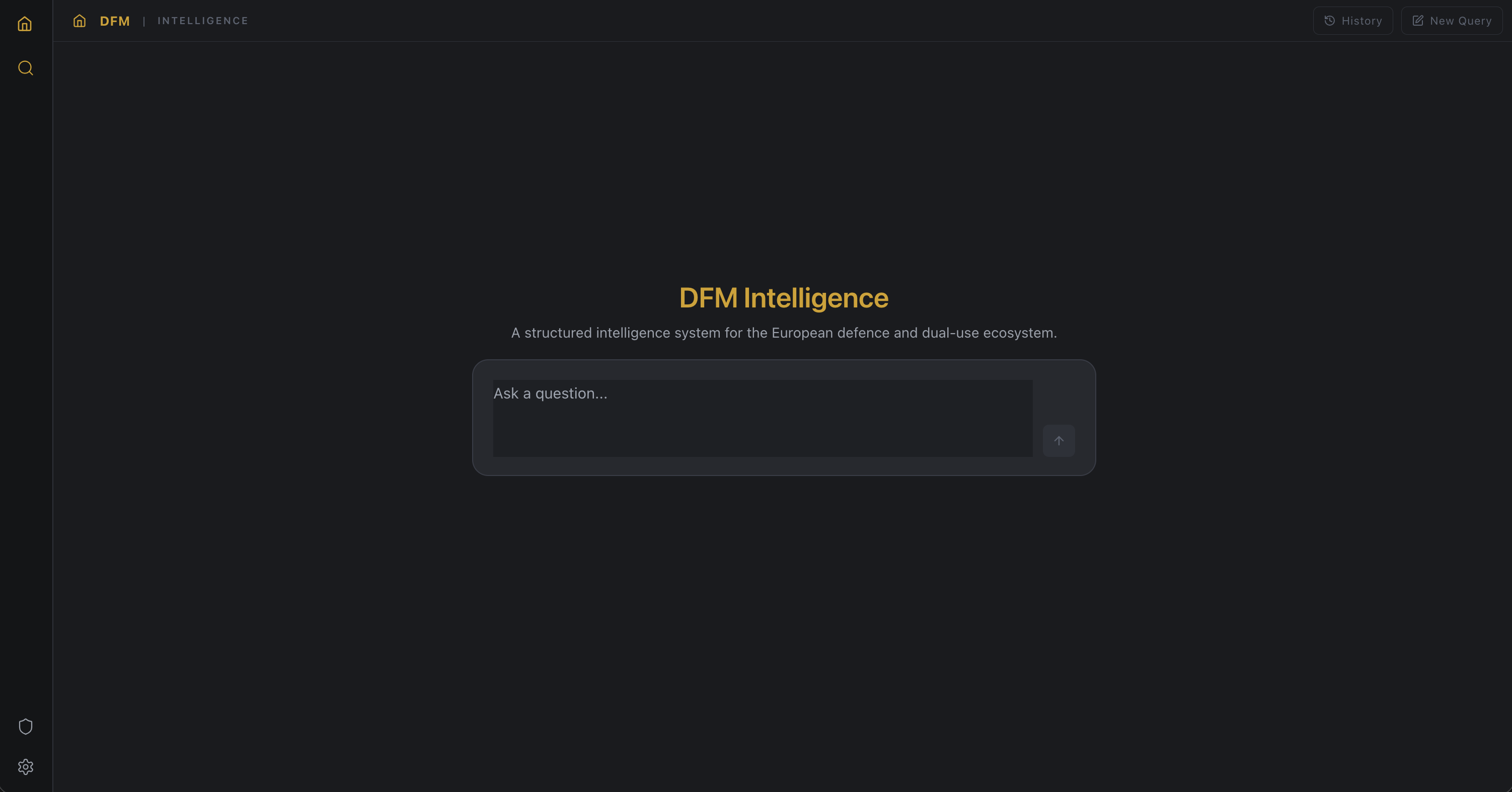
Defence Finance Monitor is not an editorial product. It is a cognitive platform built to identify the enterprises and technologies that matter against European strategic priorities and the architecture of transatlantic collective security, anchored to a verified database of more than 2,000 enterprises mapped against the European defence-industrial perimeter and extended every week with new entities as the perimeter itself evolves through procurement awards, ownership changes, regulatory notifications and programme participation. Mapping a Tier-2 or Tier-3 supplier base behind a single prime contractor, identifying which firms in a portfolio are exposed to EDIP origin rules, Golden Power notifications or critical raw materials dependencies, reconstructing contract awards under EDF, EDIRPA and ASAP, tracing ownership cascades behind a strategic asset — work that used to require weeks of analyst coordination now resolves inside a single structured query, with confidence levels marked for every statement and citations to official institutional sources. For a law firm partner, a corporate development team, a sovereign fund or a procurement office, the consequence is direct: the work that used to define the cost and timing of a deliverable now defines the starting point of an analysis. Institutional research stops being a project and becomes a capability.
DFM Intelligence is reserved for subscribers to the DFM annual programme.
For further information about DFM Intelligence, access conditions or payment by bank transfer, please contact: mastrolia@stroncature.com