

Defence Finance Monitor applies a top–down method that traces how NATO, EU and allied strategic priorities are translated into regulations, funding lines and procurement programmes, and then into demand for specific capabilities, technologies and companies. We use official doctrine as the organising frame to identify where strategic relevance is being institutionally defined and where it is materialising in concrete budgets, acquisition pathways and industrial capacity.
Our working assumption is that what becomes structurally relevant in NATO/EU strategy tends, over time, to become relevant also from a financial and industrial point of view. In the European context, this includes the progressive operationalisation of strategic autonomy: the effort to reduce critical dependencies, secure supply chains, strengthen the European defence technological and industrial base, and align regulatory, financial and procurement instruments with long-term security objectives. On this basis, DFM operates as a decision-support tool: it benchmarks investment and industrial choices against institutional demand, clarifies which capabilities are rising on the spending agenda, and maps the funding instruments, eligibility constraints and supply-chain factors that shape real-world feasibility across investors, industry, public authorities and research organisations.
Defence Finance Monitor rests on a single analytical premise: within the Euro-Atlantic security architecture, strategic doctrine precedes regulation and capability planning, regulation precedes budgets, and budgets shape markets.
Quantum Technologies and European Defence Sovereignty
Europe’s quantum agenda is no longer confined to research policy or long-term scientific ambition. It is becoming a strategic sovereignty issue that links cyber resilience, secure government communications, space infrastructure, defence R&D, dual-use export controls, industrial scale-up and public capital. The central question is whether Europe can convert its scientific base into deployable systems, trusted supply chains and companies able to support defence, critical infrastructure and sovereign communications before the end of the decade.
This report reconstructs the emerging European quantum-defence architecture across four connected layers. It first analyses the strategic and regulatory framework, including the Quantum Europe Strategy, NATO’s quantum agenda, the EU post-quantum cryptography roadmap, EDIP, EDF and dual-use controls. It then examines EuroQCI, IRIS², QKD and PQC as infrastructure for secure communications, before assessing quantum sensing, navigation, computing and defence-relevant capability pathways. The final section maps the industrial and financial architecture, including European scale-ups, national quantum strategies, public investment vehicles, defence primes, venture capital, M&A risks and the implications for institutional investors.
European Defence Equity Capital Formation 2025–2030
Europe’s defence build-up is no longer only a matter of procurement budgets, industrial capacity and emergency rearmament. It is beginning to reshape the structure of capital formation itself. Public markets, private rounds, sponsor exits, strategic spin-offs and state-shaped listings are becoming part of the financial infrastructure through which defence companies scale, governments preserve strategic control, investors gain exposure to long-cycle military demand, and industrial groups clarify the value of assets previously embedded inside broader conglomerates.
This report examines the emerging European defence equity capital market from 2025 to 2030. It analyses the Hensoldt, RENK, Exosens, TKMS and CSG precedents; assesses the credible pipeline around KNDS, Eurenco, Patria and other strategic candidates; distinguishes IPOs from spin-offs, carve-outs and capital recycling; evaluates private defence-tech rounds involving companies such as Helsing, Quantum Systems and ARX Robotics; and tests whether a meaningful ECM and advisory fee pool is forming for banks, law firms, sponsors and institutional investors. The report also examines valuation logic, ESG repricing, sovereign constraints and the role of defence ECM as a new layer of European strategic autonomy.
Sovereign Cloud and Edge Computing Defence
European defence is moving into an environment where cloud, edge computing and AI infrastructure are no longer ordinary IT choices. They are becoming strategic-control questions. Defence organisations must decide which workloads can run on commercial or sovereign public cloud, which require national or EU-controlled environments, which must remain air-gapped, and which need edge processing for degraded, disconnected or latency-sensitive operations. The central issue is therefore not simply data location, but legal control, operational autonomy, supply-chain resilience, access to advanced compute and exposure to non-European technological dependencies.
This report analyses sovereign cloud and edge computing for defence through the interaction of EU policy, procurement, regulation, infrastructure and provider models. It examines the Commission’s Cloud Sovereignty Framework, the 2026 sovereign cloud procurement, EuroHPC, AI Factories, the AI Continent agenda, GAIA-X, EuroStack, national sovereign-cloud models and the role of hyperscaler sovereign offerings. It then assesses how these developments affect defence primes, public buyers, investors, banks, M&A advisers and regulatory counsel, with particular attention to workload classification, classified-information handling, portability, edge survivability and the unresolved dependence on non-European silicon and cloud technology stacks.
DFM Intelligence · Platform Capability
Problems DFM Intelligence Now Solves
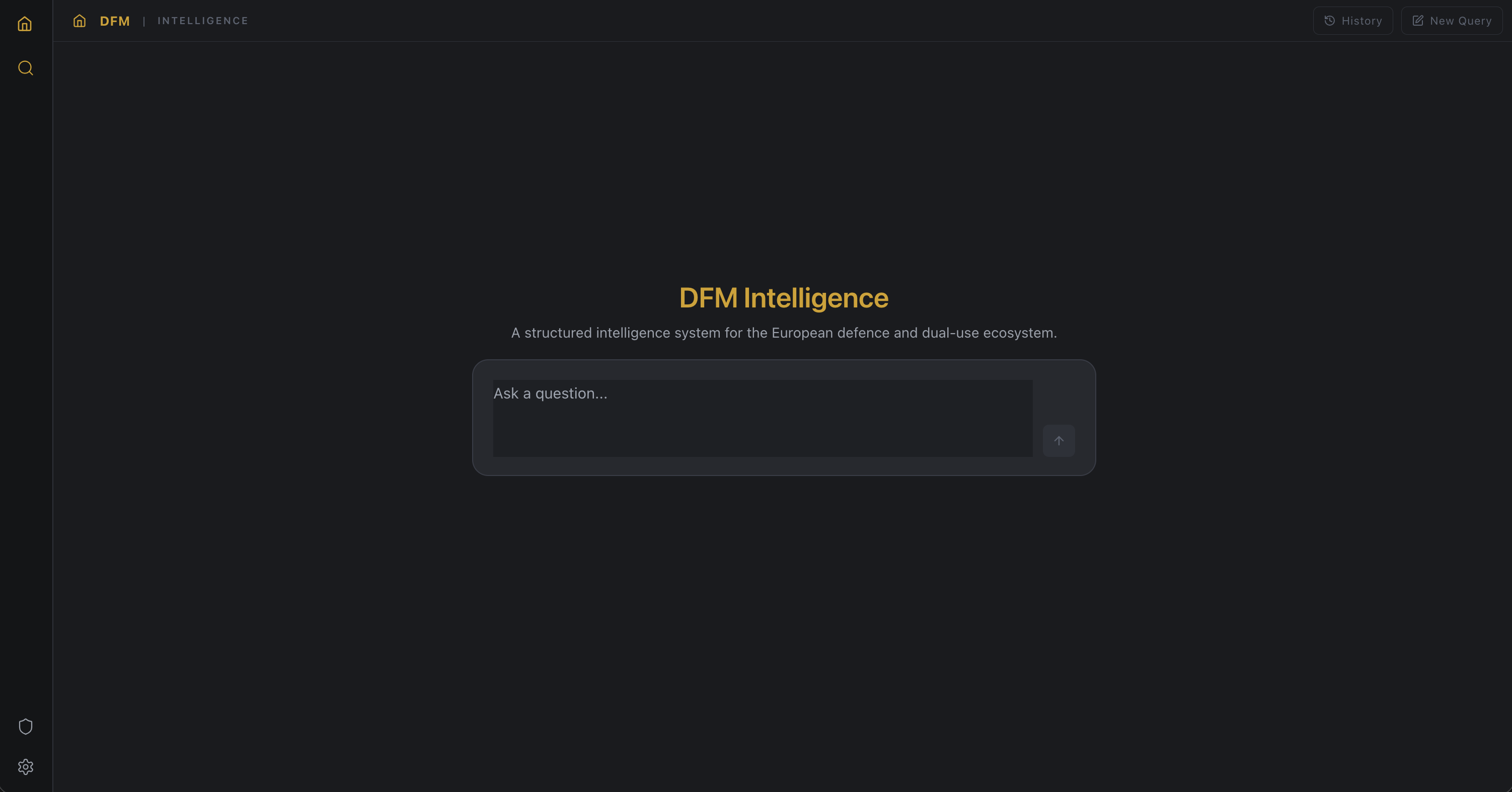
Defence Finance Monitor is not an editorial product. It is a cognitive platform built to identify the enterprises and technologies that matter against European strategic priorities and the architecture of transatlantic collective security, anchored to a verified database of more than 2,000 enterprises mapped against the European defence-industrial perimeter and extended every week with new entities as the perimeter itself evolves through procurement awards, ownership changes, regulatory notifications and programme participation. Mapping a Tier-2 or Tier-3 supplier base behind a single prime contractor, identifying which firms in a portfolio are exposed to EDIP origin rules, Golden Power notifications or critical raw materials dependencies, reconstructing contract awards under EDF, EDIRPA and ASAP, tracing ownership cascades behind a strategic asset — work that used to require weeks of analyst coordination now resolves inside a single structured query, with confidence levels marked for every statement and citations to official institutional sources. For a law firm partner, a corporate development team, a sovereign fund or a procurement office, the consequence is direct: the work that used to define the cost and timing of a deliverable now defines the starting point of an analysis. Institutional research stops being a project and becomes a capability.
DFM Intelligence is reserved for subscribers to the DFM annual programme.
For further information about DFM Intelligence, access conditions or payment by bank transfer, please contact: mastrolia@stroncature.com