

Defence Finance Monitor applies a top–down method that traces how NATO, EU and allied strategic priorities are translated into regulations, funding lines and procurement programmes, and then into demand for specific capabilities, technologies and companies. We use official doctrine as the organising frame to identify where strategic relevance is being institutionally defined and where it is materialising in concrete budgets, acquisition pathways and industrial capacity.
Our working assumption is that what becomes structurally relevant in NATO/EU strategy tends, over time, to become relevant also from a financial and industrial point of view. In the European context, this includes the progressive operationalisation of strategic autonomy: the effort to reduce critical dependencies, secure supply chains, strengthen the European defence technological and industrial base, and align regulatory, financial and procurement instruments with long-term security objectives. On this basis, DFM operates as a decision-support tool: it benchmarks investment and industrial choices against institutional demand, clarifies which capabilities are rising on the spending agenda, and maps the funding instruments, eligibility constraints and supply-chain factors that shape real-world feasibility across investors, industry, public authorities and research organisations.
Defence Finance Monitor rests on a single analytical premise: within the Euro-Atlantic security architecture, strategic doctrine precedes regulation and capability planning, regulation precedes budgets, and budgets shape markets.
European Security & Defence Industry · Strategic Intelligence
From US Drawdown to European Capability Replacement
Italy, NATO Burden Reallocation and the Financial Architecture of Strategic Autonomy
Europe’s defence debate is leaving the phase of declarations and entering the phase of execution. The question is no longer whether European states should spend more, but whether they can replace the high-end conventional enablers — command and control, satellite reconnaissance, persistent ISR, strategic airlift, electronic warfare, power-projection logistics — that the United States has historically supplied inside NATO. A gradual U.S. force adjustment in Europe, even without a confirmed Italy-specific withdrawal order, has already changed the planning baseline for European governments, defence industries and capital providers. NATO’s Supreme Allied Commander Europe has stated that further redeployments should be expected as Europe assumes more of the conventional burden, and Reuters has reported that Washington plans to shrink the pool of U.S. capabilities earmarked for NATO under the Force Model in a major crisis. Italy is the most consequential southern-flank test case because its territory hosts a uniquely dense combination of U.S. and NATO functions across airpower, maritime command, logistics prepositioning, southern-hub intelligence and Mediterranean power projection — a concentration that no other European state matches. The report distinguishes confirmed public evidence from scenarios, reconstructs the capability replacement problem behind the slogan of strategic autonomy through the Kiel Institute’s €500 billion / €50 billion-per-year framework, separates instruments already in force (SAFE, national escape clause) from large envelopes still at the proposal stage, and demonstrates why the often-cited arithmetic that turns proposed EU budget envelopes into a near-complete funding stack is too generous. It identifies where the dedicated funding gap is in fact larger than headline residuals imply, and translates the architecture into the capability layers, financing channels and corporate categories that will capture the real value of the European replacement cycle.
European Security & Defence Industry · Industrial Intelligence
Defence Workforce Architecture in Europe
The Skills Bottleneck Behind Defence Industrial Readiness
Europe’s defence problem is no longer defined only by budgets, procurement plans or industrial capacity. The decisive constraint is increasingly human: the ability to convert rising defence expenditure into engineers, technicians, cyber specialists, software developers, production workers, maintainers and programme managers fast enough to sustain rearmament. The European Defence Agency reported total defence expenditure of €343 billion in 2024 and projected €381 billion in 2025 in constant terms, while the White Paper for European Defence makes explicit that industrial ramp-up requires the sector to attract, train and reskill far more talent across the entire capability cycle. The labour-market backdrop turns this into an operational difficulty even before defence-specific scarcity is isolated: Eurostat reports a job-vacancy rate of 3.1% in professional, scientific and technical activities in early 2025, and 57.5% of EU enterprises that tried to recruit ICT specialists in 2023 had difficulty filling those vacancies, with Germany above 72%. Defence is now recruiting from exactly those labour pools that are already structurally tight. The report distinguishes binding law from policy strategies and funding channels, separates EDIP from the Union of Skills, ESF+, the Digital Europe Programme and the Pact for Skills, and corrects a series of imprecise public claims — including the often-cited 500,000-700,000 workforce gap, the proposition that EDIP Article 16 contains a workforce chapter, and the timing of Germany’s 460,000-personnel target. It then analyses national talent strategies in Germany, France, Italy, Poland and the United Kingdom, and translates the workforce variable into a financially material indicator of industrial readiness — one that backlog, capex and order intake alone no longer capture.
European Security & Defence Industry · Industrial Intelligence
Synthetic Biology and Biotech Defence in Europe, 2026–2030
Medical Countermeasures, Biosurveillance and Dual-Use Manufacturing in Europe’s Emerging Security Architecture
Synthetic biology and biotech defence have entered Europe’s security agenda because biological risk can no longer be treated as a public-health issue alone. Pandemics, deliberate biological release, CBRN incidents, antimicrobial resistance, contested logistics and critical-medicine shortages now form part of the same strategic environment, and the European response — still dispersed across health security, defence R&D, export controls, stockpiling, surveillance, industrial policy and treaty compliance — has begun to crystallise into a regulated defence-adjacent infrastructure. The Commission’s Medical Countermeasures Strategy of July 2025 placed medical countermeasures inside a civil-military preparedness frame, announced RAMP UP and a 2026 Medifence initiative for CBRN and armed-conflict-related threats, and proposed expansion of EU FAB beyond its current vaccine focus. The 2026 European Defence Fund work programme created an explicit defence medical response, CBRN, biotech and human factors category, funding the Defence Medical Countermeasures Alliance through a €6.5 million research grant and an €18.5 million development grant, plus a further €15 million on decontamination technologies. The verified industrial base sits on EU FAB’s contracted ceiling of 325 million vaccine doses per year, Germany’s ZEPAI standby model, and a layered CDMO ecosystem in RNA, viral vectors, sterile injectables and advanced biologics. The report distinguishes binding law from strategies and proposals, separates verified European programmes from market overclaims about soldier enhancement or an EU DARPA-equivalent, maps the industrial chain across reserved manufacturing capacity, biosurveillance, deployable diagnostics, CBRN protection and broad-spectrum therapeutics, and identifies where public programmes, regulatory constraints and industrial capabilities are likely to create investable and strategically relevant opportunities through 2030.
DFM Intelligence · Platform Capability
Problems DFM Intelligence Now Solves
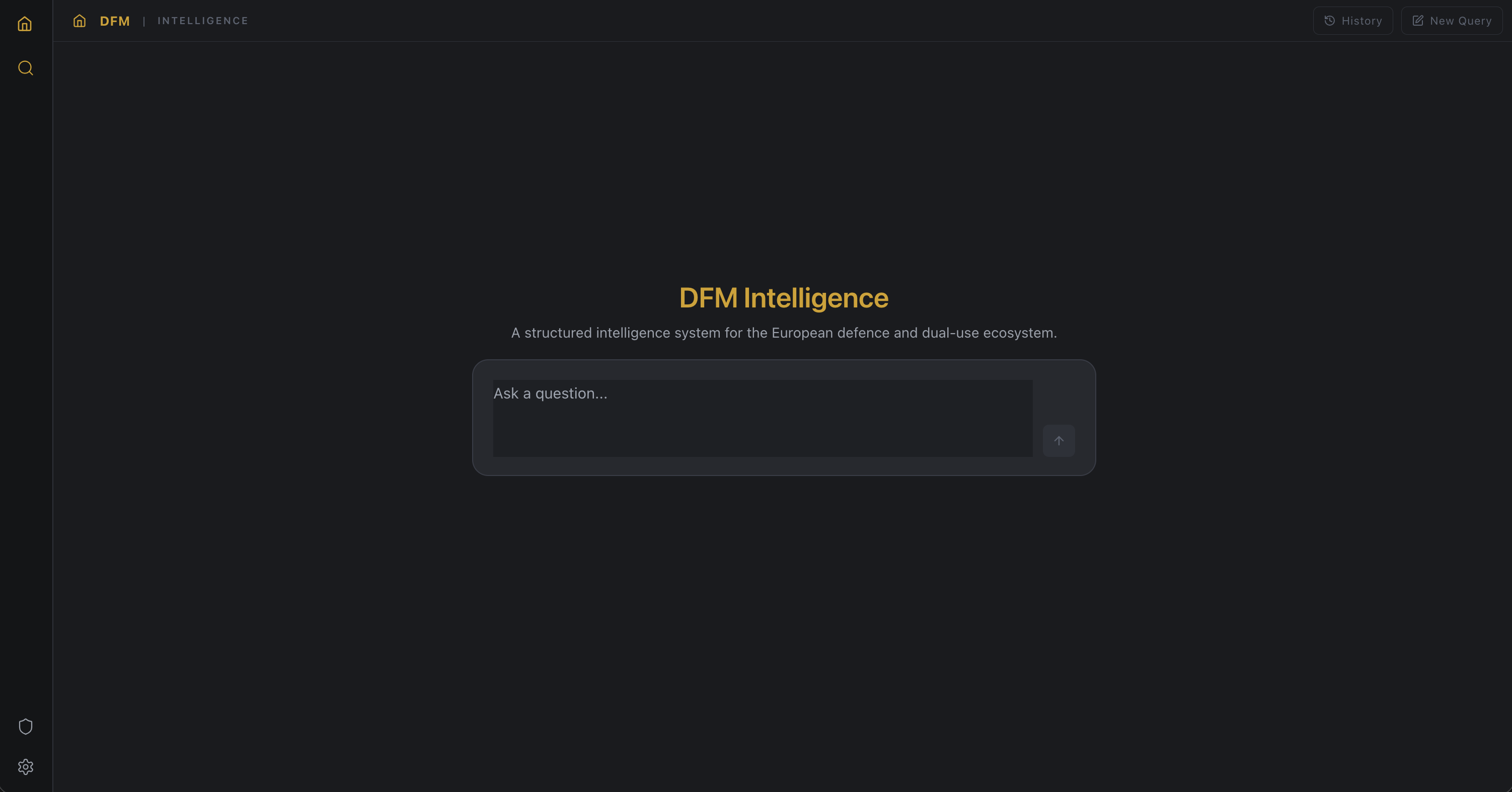
Defence Finance Monitor is not an editorial product. It is a cognitive platform built to identify the enterprises and technologies that matter against European strategic priorities and the architecture of transatlantic collective security. The published analyses are one surface of the system; beneath them sits the layer that institutional users come for, a decisional intelligence tool through which strategic priorities are translated into concrete entities, dependencies and exposures rather than into commentary about them. The platform is anchored to a verified database of more than 2,000 enterprises mapped against the European defence-industrial perimeter, updated continuously and extended every week with new entities as the perimeter itself evolves through procurement awards, ownership changes, regulatory notifications and programme participation. Mapping a Tier-2 or Tier-3 supplier base behind a single prime contractor, identifying which firms in a portfolio are exposed to EDIP origin rules, Golden Power notifications or critical raw materials dependencies, reconstructing contract awards under EDF, EDIRPA and ASAP, tracing ownership cascades behind a strategic asset — work that used to require weeks of analyst coordination now resolves inside a single structured query, with confidence levels marked for every statement and citations to official institutional sources: European Union legislation, Council and Commission communications, EDA defence data, national investment-screening publications, EIB project records, company filings. There is no statistical fabrication on open web content, no opaque generative output, no source that cannot be checked. For a law firm partner, a corporate development team, a sovereign fund or a procurement office, reading the analyses establishes the strategic frame; using the platform converts that frame into the entities, contracts, programmes and regulatory exposures on which a decision can actually be taken. DFM Intelligence is the layer at which institutional research stops being a project and becomes a capability — the point at which the question is no longer what to read, but what to ask.
DFM Intelligence is reserved for subscribers to the DFM annual programme.
For further information about DFM Intelligence, access conditions or payment by bank transfer, please contact: mastrolia@stroncature.com