

Defence Finance Monitor applies a top–down method that traces how NATO, EU and allied strategic priorities are translated into regulations, funding lines and procurement programmes, and then into demand for specific capabilities, technologies and companies. We use official doctrine as the organising frame to identify where strategic relevance is being institutionally defined and where it is materialising in concrete budgets, acquisition pathways and industrial capacity.
Our working assumption is that what becomes structurally relevant in NATO/EU strategy tends, over time, to become relevant also from a financial and industrial point of view. In the European context, this includes the progressive operationalisation of strategic autonomy: the effort to reduce critical dependencies, secure supply chains, strengthen the European defence technological and industrial base, and align regulatory, financial and procurement instruments with long-term security objectives. On this basis, DFM operates as a decision-support tool: it benchmarks investment and industrial choices against institutional demand, clarifies which capabilities are rising on the spending agenda, and maps the funding instruments, eligibility constraints and supply-chain factors that shape real-world feasibility across investors, industry, public authorities and research organisations.
Defence Finance Monitor rests on a single analytical premise: within the Euro-Atlantic security architecture, strategic doctrine precedes regulation and capability planning, regulation precedes budgets, and budgets shape markets.
European Security & Defence Industry · Capital Markets Intelligence
National Promotional Banks and the Bilateral Architecture of European Defence Finance
How KfW, Bpifrance, BGK, CDP, ICO and SID Bank Are Reshaping the Public Balance Sheet Behind European Rearmament
The most consequential development in European defence finance between 2024 and 2026 is not the widening of the European Investment Bank Group’s security and defence perimeter. It is the parallel crystallisation of explicit national promotional bank mandates, which has produced a bilateral public-finance architecture that does not appear in any single regulation but determines, in practice, which defence borrowers can actually be funded. KfW, Bpifrance and BGK have each formalised a defence-finance role with a precision that the EU-level instruments do not match, while CDP, ICO and SID Bank occupy more heterogeneous positions. The shift matters because munitions, weapons production, export finance, strategic suppliers and capex-heavy industrial expansion remain unevenly served by SAFE, EDIP and the EIB Group’s intermediated model, and the gap is being filled at member-state level by institutions whose mandates, exclusion policies and balance sheets are structurally different. The decisive question for primes, lenders and counsel is no longer whether public finance is available to defence. It is which public-finance layer, national or supranational, matches the borrower’s industrial profile, and which combination of EU-law discipline and national promotional logic a transaction must pass through to close. The report reconstructs the perimeter bank by bank, identifies the verified instruments, and translates the architecture into financing strategy for primes, defence-tech scale-ups, syndicated-loan practitioners and regulatory counsel operating across the new public-private envelope.
European Security & Defence Industry · Industrial Intelligence
The Industrial Inversion of Military Assistance
How Build with Ukraine and BraveTech EU Are Reshaping Europe’s Defence-Industrial Relationship with Ukraine
Western military assistance to Ukraine began as a familiar mechanism: donor states financed equipment, Western industry produced it, Ukraine absorbed it under wartime conditions. That model remains indispensable, but it has stopped describing the full industrial reality. Through Build with Ukraine, BraveTech EU and a growing layer of company-level joint ventures, Ukrainian battlefield-validated designs, rapid iteration cycles and operational feedback are now entering European industrial planning as upstream inputs rather than downstream demand. The shift is anchored in law in force, not only in political messaging: SAFE places Ukrainian content inside the 65% preferred-origin zone of EU defence procurement, EDIP earmarks €300 million for a dedicated Ukraine Support Instrument, and the December 2025 mini-defence omnibus opens EDF participation to Ukrainian entities on equal terms. The industrial geography is moving with the regulation. Quantum Frontline Industries moved from joint-venture formation to first deliveries in less than four months, Auterion-Airlogix has signed German government cooperation for serial production, Ukrspecsystems has opened a £200 million Suffolk facility, and Fire Point is preparing solid rocket fuel production near a Danish air base. These cases are not isolated solidarity gestures. They are the visible edge of a structural reorganisation in which donor governments now finance production lines abroad for systems conceived in Ukraine, and the same lines may eventually supply the host country’s own armed forces. The report reconstructs the regulatory backbone, separates verified company cases from announced memoranda, and identifies the operational indicators — conversion rate, cycle time, scale depth, institutional absorption, dual-market penetration — that will determine whether industrial inversion becomes a durable feature of European rearmament or remains a wartime experiment.
European Security & Defence Industry · Strategic Intelligence
Sovereign Compute for European Defence
Cloud, Edge Infrastructure and AI Compute as the New Control Layer of Strategic Autonomy
European defence autonomy can no longer be assessed only through platforms, budgets and industrial capacity. Modern military power depends on a computational layer through which operational data, AI models, command systems, logistics networks, simulation environments and edge applications are stored, trained, processed and deployed. A continent can fund new capabilities and expand production while remaining dependent if the cloud, compute and edge infrastructure beneath those capabilities is governed by non-European legal regimes, non-European operational control or non-European hardware roadmaps. The European Commission has moved from rhetoric on digital sovereignty to measurable procurement criteria through its 2025 Cloud Sovereignty Framework and its April 2026 sovereign cloud award to four provider groupings, and has paired that with compute-capacity policy through EuroHPC, AI Factories and the planned Cloud and AI Development Act. The result is not a binary between European cloud and hyperscaler cloud. It is a graded model in which workload class, jurisdiction, supply-chain dependency and edge survivability determine which sovereignty mechanism applies. The market has converged on at least four distinct sovereign patterns, ranging from fully European-operated stacks to European-controlled wrappers around non-European technology, with Italy’s PSN, France’s SecNumCloud, Germany’s data-centre concentration and the hyperscalers’ separate sovereign realms each illustrating a different approach. The harder problem sits at the silicon layer, where Europe can govern where compute is run but cannot yet claim end-to-end sovereignty over chips, firmware pathways or servicing chains. The report distinguishes law in force from policy proposals, clarifies the verified status of GAIA-X and EuroStack against frequent market overclaim, and translates the architecture into a workload-segmented selection framework for primes, investors, counsel and procurement authorities navigating the gap between sovereign operation and full-stack sovereignty.
DFM Intelligence · Platform Capability
Problems DFM Intelligence Now Solves
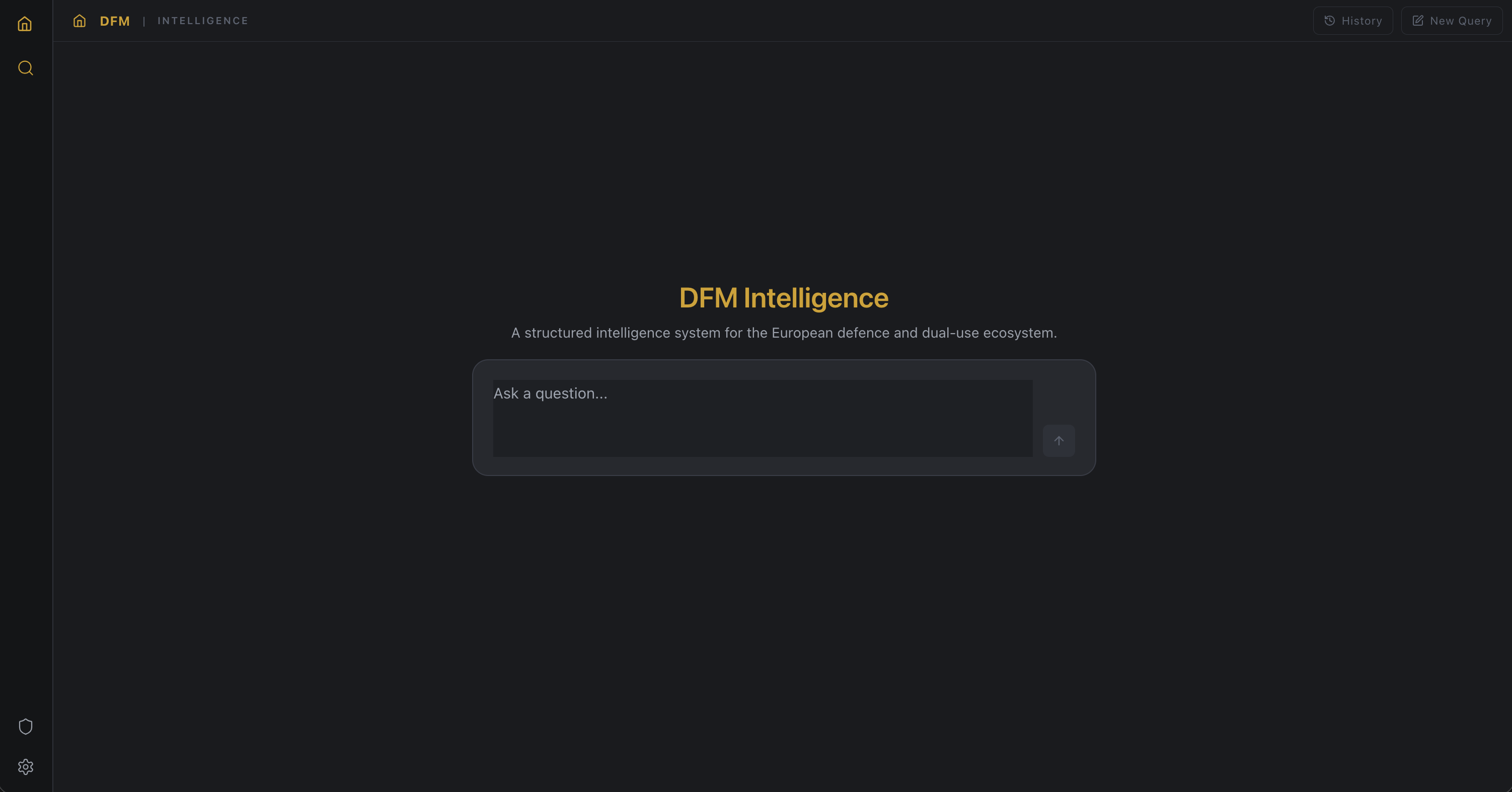
Defence Finance Monitor is not an editorial product. It is a cognitive platform built to identify the enterprises and technologies that matter against European strategic priorities and the architecture of transatlantic collective security. The published analyses are one surface of the system; beneath them sits the layer that institutional users come for, a decisional intelligence tool through which strategic priorities are translated into concrete entities, dependencies and exposures rather than into commentary about them. The platform is anchored to a verified database of more than 2,000 enterprises mapped against the European defence-industrial perimeter, updated continuously and extended every week with new entities as the perimeter itself evolves through procurement awards, ownership changes, regulatory notifications and programme participation. Mapping a Tier-2 or Tier-3 supplier base behind a single prime contractor, identifying which firms in a portfolio are exposed to EDIP origin rules, Golden Power notifications or critical raw materials dependencies, reconstructing contract awards under EDF, EDIRPA and ASAP, tracing ownership cascades behind a strategic asset — work that used to require weeks of analyst coordination now resolves inside a single structured query, with confidence levels marked for every statement and citations to official institutional sources: European Union legislation, Council and Commission communications, EDA defence data, national investment-screening publications, EIB project records, company filings. There is no statistical fabrication on open web content, no opaque generative output, no source that cannot be checked. For a law firm partner, a corporate development team, a sovereign fund or a procurement office, reading the analyses establishes the strategic frame; using the platform converts that frame into the entities, contracts, programmes and regulatory exposures on which a decision can actually be taken. DFM Intelligence is the layer at which institutional research stops being a project and becomes a capability — the point at which the question is no longer what to read, but what to ask.
DFM Intelligence is reserved for subscribers to the DFM annual programme.
For further information about DFM Intelligence, access conditions or payment by bank transfer, please contact: mastrolia@stroncature.com