

Defence Finance Monitor applies a top–down method that traces how NATO, EU and allied strategic priorities are translated into regulations, funding lines and procurement programmes, and then into demand for specific capabilities, technologies and companies. We use official doctrine as the organising frame to identify where strategic relevance is being institutionally defined and where it is materialising in concrete budgets, acquisition pathways and industrial capacity.
Our working assumption is that what becomes structurally relevant in NATO/EU strategy tends, over time, to become relevant also from a financial and industrial point of view. In the European context, this includes the progressive operationalisation of strategic autonomy: the effort to reduce critical dependencies, secure supply chains, strengthen the European defence technological and industrial base, and align regulatory, financial and procurement instruments with long-term security objectives. On this basis, DFM operates as a decision-support tool: it benchmarks investment and industrial choices against institutional demand, clarifies which capabilities are rising on the spending agenda, and maps the funding instruments, eligibility constraints and supply-chain factors that shape real-world feasibility across investors, industry, public authorities and research organisations.
Defence Finance Monitor rests on a single analytical premise: within the Euro-Atlantic security architecture, strategic doctrine precedes regulation and capability planning, regulation precedes budgets, and budgets shape markets.
European Security & Defence Industry · Regulatory Intelligence
The Defence Readiness Omnibus: Europe’s Constitutional Stress Test for Defence-Industrial Integration. Eligibility, National Control and the Future of Europe’s Defence Market
The Defence Readiness Omnibus is not a simplification package. It is the moment at which the European Union discovers whether higher defence spending will create a more integrated industrial market or simply finance twenty-seven parallel national systems with greater resources. Eligibility rules, “Buy European” criteria, Article 346 TFEU, national investment screening and Golden Power-type controls now sit at the centre of the same legal contest, and the trilogue dispute that remained open on 19 May 2026 is not a marginal drafting issue but the point at which two legal grammars collide. The report distinguishes law in force from legislative proposals from political agreements, reconstructs the seven-instrument package adopted between June and December 2025, examines the legal asymmetry between EU market-making and the screening regimes intensifying in France, Germany and Italy, and tests the framework against three live transactions — Leonardo/Iveco, Rheinmetall/NVL and KNDS/Texelis — that reveal what European consolidation actually looks like under current law. It identifies the four drafting points in the trilogue that will determine whether post-2026 defence finance flows through an integrated single market or through a more heavily funded archipelago of national champions.
European Security & Defence Industry · Industrial Intelligence
Europe’s Kill Web Moment. How Agentic AI, Counter-UxS Systems and Software-Defined Architectures Are Reshaping European Defence Industry
Much of the public debate on European defence M&A still treats the platform — the airframe, the hull, the vehicle — as the decisive industrial asset. The legal documents now in force point in a different direction. EDIP procurement clauses explicitly require contracts to allow fast upgrades from battlefield lessons; the Defence Readiness Roadmap calls for modular, interoperable systems with open architecture; the European Drone Defence Initiative is built around linked sensors and effectors across the Union. Together these signals describe a shift from platform builders to system orchestrators — firms that control mission software, autonomy stacks, tactical compute, data fusion and the upgrade loop that determines whether a fielded system can adapt before the threat does. The report maps the six value pools of the emerging architecture, separates demonstrated orchestration moves from aspirational positioning across Helsing, Anduril, Quantum Systems, Tekever, Stark Defence, Comand AI and the established primes, and identifies the five public signals over the next eighteen months that will reveal who captures Europe’s defence value pool by 2030 — and who is left manufacturing components inside architectures controlled by faster companies.
European Security & Defence Industry · Strategic Intelligence
Signal Sovereignty. Europe’s Race to Secure Satellite Communications, Navigation and Timing in a Degraded Battlespace
Europe’s defence integration debate concentrates on platforms, primes and procurement, but the layer that determines whether any of those assets remain operational under stress sits elsewhere — in the signal. Assured communications, assured positioning, assured timing: these are the functions on which command, targeting, logistics and survivability depend, and they are the functions Europe is currently building rather than fielding. IRIS² is law in force, GOVSATCOM is in initial service, Galileo Public Regulated Service exists in initial configuration; yet jamming and spoofing incidents have risen sharply since 2022 across the Baltic, Black Sea, Mediterranean and Arctic regions, and Europe’s sovereign replacement architecture is not scheduled for services until 2030. The vulnerability is not that Europe lacks programmes. It is that the most security-sensitive layers — protected waveforms, hardened terminals, PRS receivers, rad-hard electronics, resilient timing, cryptographic key distribution — are arriving in sequence rather than simultaneously. The report separates law in force from policy proposals across the EU, ESA, EUSPA and NATO stack, maps the industrial chain where Europe is genuinely sovereign and where it remains exposed, and identifies the component layers below the prime-contractor tier where industrial leverage exceeds public visibility — the layers that will determine whether legal sovereignty becomes operational sovereignty before the late-decade deployment cycle closes.
DFM Intelligence · Platform Capability
Problems DFM Intelligence Now Solves
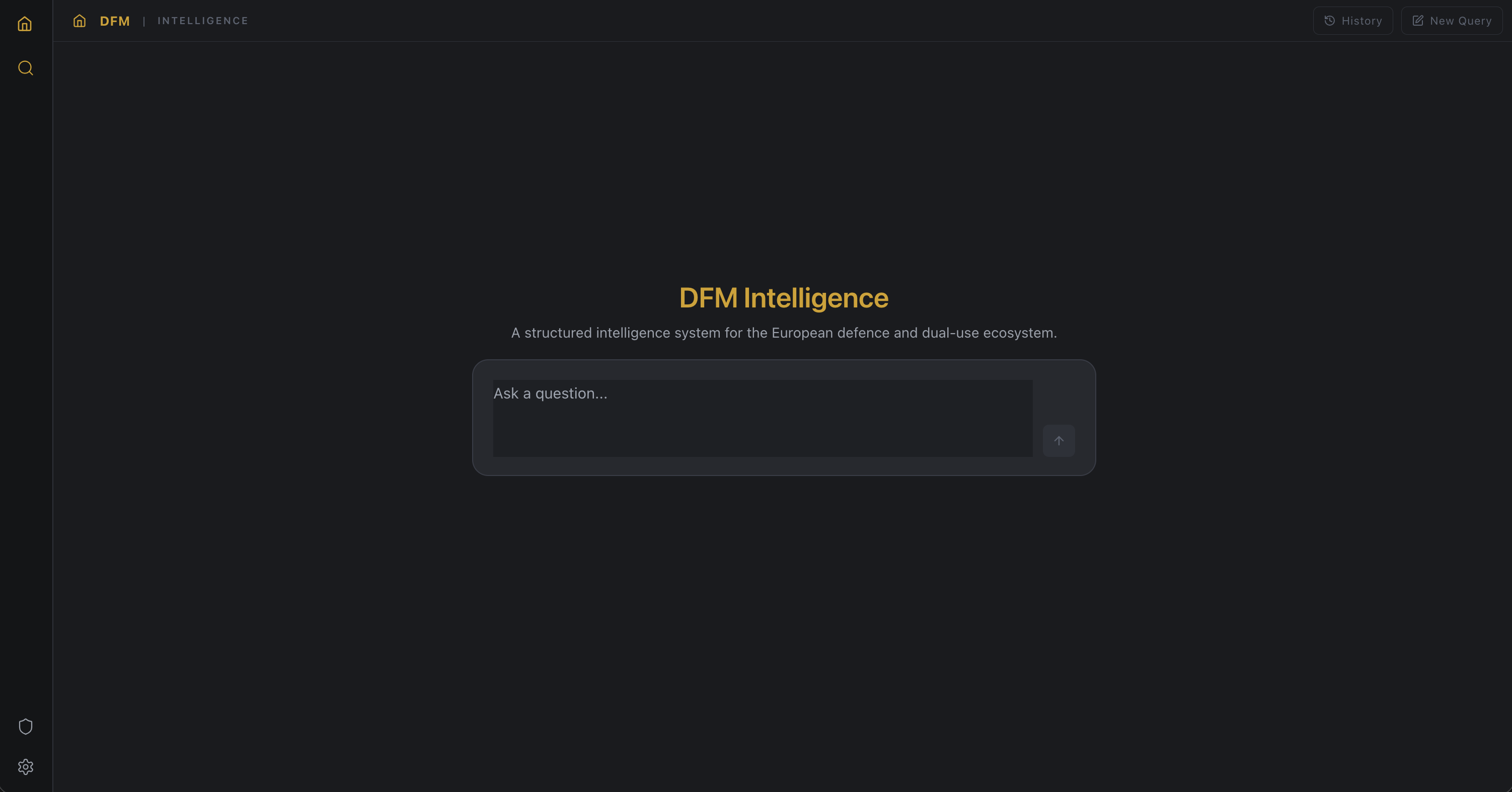
Mapping a Tier-2 or Tier-3 supplier base behind a single prime contractor used to require weeks of analyst coordination across procurement databases, company filings, programme registries and national disclosures. DFM Intelligence resolves it in a single working session. The same applies to regulatory exposure: identifying which firms in a portfolio are affected by EDIP origin rules, Golden Power notifications, FDI screening intensification or critical raw materials dependencies no longer requires assembling parallel datasets — the answer sits inside one structured query, with confidence levels marked for every statement. Competitive positioning briefs that previously depended on commissioning external research now run on a verified internal layer: contract awards under EDF, EDIRPA, ASAP and national procurement instruments, coordination patterns inside collaborative R&D programmes, M&A transactions with their conditions and pending approvals, ownership cascades behind strategic assets. Each response is anchored to verified entities in DFM’s closed ontology and cited to official institutional sources — European Union legislation, Council and Commission communications, EDA defence data, national investment-screening publications, EIB project records, company filings. There is no statistical fabrication on open web content, no opaque generative output, no source that cannot be checked. The practical consequence for a partner of a law firm, a corporate development team, a sovereign fund or a procurement office is direct: the work that used to define the cost and timing of a deliverable now defines the starting point of an analysis. DFM Intelligence is the layer at which institutional research stops being a project and becomes a capability.
DFM Intelligence is reserved for subscribers to the DFM annual programme.
For further information about DFM Intelligence, access conditions or payment by bank transfer, please contact: mastrolia@stroncature.com