

Defence Finance Monitor applies a top–down method that traces how NATO, EU and allied strategic priorities are translated into regulations, funding lines and procurement programmes, and then into demand for specific capabilities, technologies and companies. We use official doctrine as the organising frame to identify where strategic relevance is being institutionally defined and where it is materialising in concrete budgets, acquisition pathways and industrial capacity.
Our working assumption is that what becomes structurally relevant in NATO/EU strategy tends, over time, to become relevant also from a financial and industrial point of view. In the European context, this includes the progressive operationalisation of strategic autonomy: the effort to reduce critical dependencies, secure supply chains, strengthen the European defence technological and industrial base, and align regulatory, financial and procurement instruments with long-term security objectives. On this basis, DFM operates as a decision-support tool: it benchmarks investment and industrial choices against institutional demand, clarifies which capabilities are rising on the spending agenda, and maps the funding instruments, eligibility constraints and supply-chain factors that shape real-world feasibility across investors, industry, public authorities and research organisations.
Defence Finance Monitor rests on a single analytical premise: within the Euro-Atlantic security architecture, strategic doctrine precedes regulation and capability planning, regulation precedes budgets, and budgets shape markets.
European Security & Defence Industry · Regulatory Intelligence
Article 346 TFEU and the New Politics of European Defence Consolidation. How EU Merger Control, National FDI Regimes and Security Derogations Are Reshaping Cross-Border Defence M&A
European defence consolidation is entering a phase in which the decisive constraint is no longer political will or industrial logic. It is the layered legal architecture through which Member States can condition, delay or restructure cross-border transactions. Most market commentary continues to treat Article 346 TFEU as the central instrument in that architecture. It is not. The real operational risk sits elsewhere, in an interaction between EU merger law, national special powers and Treaty-freedom scrutiny that has become materially more contested since 2025 and that will shape every significant defence M&A through 2030. The report identifies where that risk actually concentrates, which national regimes behave in fundamentally different ways despite appearing similar from outside, and which transaction structures are now systematically more defensible than others. It also assesses what the Commission’s draft Merger Guidelines, now in public consultation, will change for deal teams, primes, private capital and sovereign investors, and what they will not change.
European Security & Defence Industry · Industrial Intelligence
Advanced Materials for European Defence. The Upstream Industrial Layer Behind Europe’s First Tier-2 Consolidation Wave
European defence readiness will not be decided by primes or platforms. It will be decided by a less visible layer of qualified materials, processes and suppliers — the layer where titanium, superalloys, composites, ceramics, coatings and specialist optics actually constrain what Europe can produce, certify and sustain. That layer is now where the first Tier-2 consolidation wave of 2026–2030 is most likely to emerge, and the conditions that make it so are already in place. The report identifies which sub-segments of the advanced-materials base are mature for consolidation and which are not, which assets are most exposed to sovereignty review and which to PE roll-up logic, and which transaction template — already documented in one major French case — is becoming the reference structure for the next phase of European industrial statecraft. It also separates the segments where open-source diligence is sufficient from those where strategic value is bound by classification and programme structure.
European Security & Defence Industry · Access Intelligence
The European Defence Fund 2026 and the SME Innovation Pipeline. How EUDIS Is Reshaping Access to European Defence Innovation
The 2026 cycle of the European Defence Fund is not a routine annual funding round. It is the first cycle in which the Commission has assembled a coherent access architecture for smaller defence innovators, connecting early-stage discovery, collaborative R&D, cascade funding, acceleration, matchmaking and equity finance through a single sequence of instruments. For SMEs, start-ups, scale-ups and non-traditional defence actors, that means more entry points than in any previous cycle — but also more ways to misread which instrument applies to which stage, which barriers have actually been lowered and which remain fully in place. The report identifies the operational pathway through that architecture, the consortium and eligibility filters that continue to define real access, and the points at which public sources diverge from the official call documents in ways that materially affect application strategy before the September 2026 deadline.
Defence Finance Monitor · Platform Intelligence
DFM Intelligence. Structured Intelligence System for the European Defence and Dual-Use Ecosystem
The Platform
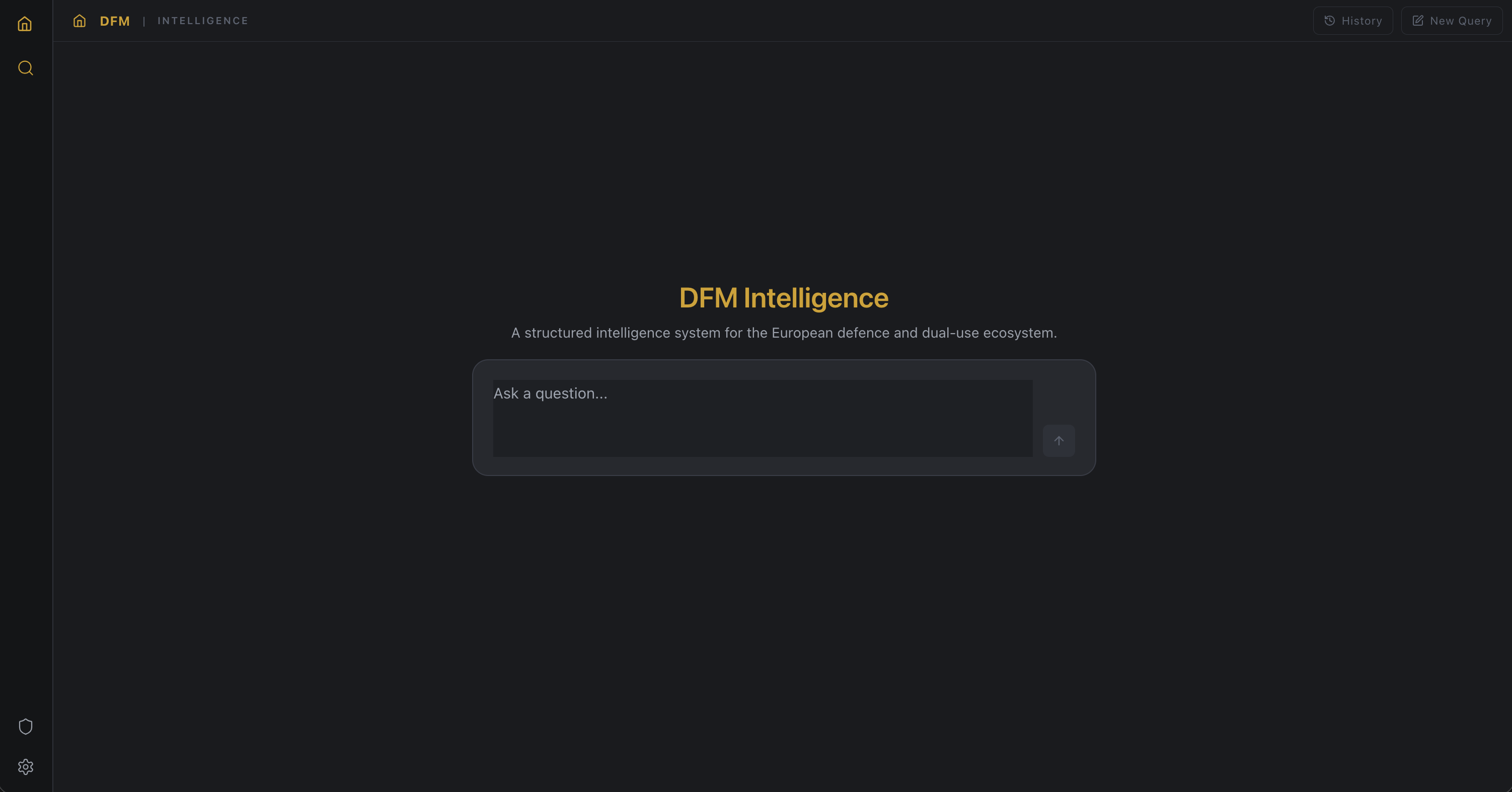
DFM Intelligence is the analytical platform that operates alongside the strategic and industrial analysis work of Defence Finance Monitor. It is a closed-ontology research engine — not a chatbot, not an aggregator — built on a structured knowledge graph of 1,915 verified European defence entities (companies, research institutes, investment funds, public institutions) connected through more than 138,000 typed relationships: supply-chain links, ownership chains, procurement contracts, co-programme participations and patent co-development. Every entity is classified against a proprietary vocabulary derived from NATO and EU strategic doctrine — 13 Strategic Priorities, 53 Operational Priorities and 52 Tactical Capabilities — alongside a separate industrial technology taxonomy of 18 domains, 108 sub-domains and 119 granular codes. The platform draws exclusively from certified institutional sources — TED procurement, CORDIS, GLEIF, EDF and EDIP beneficiary records, EPO patent data, EUR-Lex, national business registries across 25 jurisdictions, and OpenSanctions — together with the analytical research output produced by DFM over the past year. The resulting graph is currently exposed through a single surface — Live Query — designed to answer questions that would otherwise require weeks of manual cross-referencing. Two additional surfaces, the Knowledge Graph and Compare, are scheduled for release in the coming months.
The Query Layer
Live Query is the natural-language surface: given a question in plain English, the system returns a structured analytical response with citations to the specific entities and documents that support each claim. The mechanism combines two parallel retrieval paths — one that captures the meaning of the question (so “anti-drone systems” correctly reaches material indexed as “counter-UAS”), and one that catches exact names, regulation articles and contract identifiers. Both paths draw evidence exclusively from the certified data layer, never from the open web or generic AI knowledge, and only the retrieved evidence is passed to the language model that composes the answer. Each statement is pre-labelled as factual, probabilistic or interpretive, so verified evidence is always distinguishable from inference. Live Query currently handles ten question types: single-entity research, priority-to-company mapping, composite multi-criterion screening, regulatory due diligence, geographic and functional discovery, technology-to-company mapping, entity-versus-entity comparison, full sector mapping (up to 200 entities across nine analytical dimensions), multi-priority comparison, and capability gap discovery. Seven further types are scheduled in the coming months — programme coverage, geographic distribution, supply-chain tier mapping, multi-country and multi-regulation comparison, M&A activity tracking and dual-use crossover analysis.
DFM Intelligence is reserved for subscribers to the DFM annual programme.
For further information about DFM Intelligence, access conditions or payment by bank transfer, please contact: mastrolia@stroncature.com