

Defence Finance Monitor applies a top–down method that traces how NATO, EU and allied strategic priorities are translated into regulations, funding lines and procurement programmes, and then into demand for specific capabilities, technologies and companies. We use official doctrine as the organising frame to identify where strategic relevance is being institutionally defined and where it is materialising in concrete budgets, acquisition pathways and industrial capacity.
Our working assumption is that what becomes structurally relevant in NATO/EU strategy tends, over time, to become relevant also from a financial and industrial point of view. In the European context, this includes the progressive operationalisation of strategic autonomy: the effort to reduce critical dependencies, secure supply chains, strengthen the European defence technological and industrial base, and align regulatory, financial and procurement instruments with long-term security objectives. On this basis, DFM operates as a decision-support tool: it benchmarks investment and industrial choices against institutional demand, clarifies which capabilities are rising on the spending agenda, and maps the funding instruments, eligibility constraints and supply-chain factors that shape real-world feasibility across investors, industry, public authorities and research organisations.
Defence Finance Monitor rests on a single analytical premise: within the Euro-Atlantic security architecture, strategic doctrine precedes regulation and capability planning, regulation precedes budgets, and budgets shape markets.
European Security & Defence Industry · Strategic Intelligence
The Strategic Function of Long-Range Missiles. Deep Precision Strike and Deterrence in the Post-INF Era
After the collapse of the INF Treaty, conventional long-range strike has re-entered European defence planning as a structural problem rather than a doctrinal abstraction. The decisive variables are no longer declaratory: they are production contracts, launcher integration, energetic-materials throughput, seeker availability, export-control treatment of enabling technologies and the survivability of forward-deployed stockpiles. The report provides a defence-industrial reading of that transition, structured to support procurement and investment decisions rather than commentary. It maps the post-INF legal architecture — UN Charter, MTCR, ATT, Regulation (EU) 2021/821, Common Position 2008/944/CFSP — and identifies which export-control choke points constrain European cooperation on systems above 500 kilometres. It compares the American, Russian and Chinese strike architectures system by system, with range, launcher and dual-capability classification, and assesses the production economics underlying each, including the seven-year Raytheon agreement on Tomahawk, AMRAAM and SM-series lines and the MBDA 40 per cent production uplift forecast for 2026. It analyses the ELSA framework and the UK-Germany over-2,000 kilometre initiative as commercial pathways with identified workshare implications, and examines Italy’s industrial position across TESEO MK2/E, CAMM-ER, SAMP/T NG, ASTER and adjacent propulsion and EW subsystems. It closes with the budgetary, contractual and industrial signals to monitor between 2026 and 2030 — U.S. missile-production contracts, ELSA implementation milestones, German decisions on Tomahawk and Typhon, SAMP/T NG delivery cadence, Italian DPP workshare allocation — and the evidence-confidence rating attached to each.
European Security & Defence Industry · Capability Intelligence
European Electronic Warfare Landscape 2026. Primes, Scaleups, Cognitive EW and the Architecture Gap with the United States and China
Europe has strong electronic-warfare products and weak electronic-warfare architecture. The report converts that diagnosis into a structured assessment of where capability, contracts and value sit, and where they do not. It anchors the analysis in topic EDF-2026-DA-SENS-CEW, the EUR 40 million 2026 Development Action on cognitive EW, and reads its scope — combined RESM and CESM, intelligent signal analysis, dynamic emitter libraries, TDOA geolocation, combat-management-system integration, validated synthetic data — as a European requirements document rather than a research line. It tracks the CROWN–SCEPTER–CEW programme lineage with funding amounts, consortium membership, country distribution and roadmap dependencies on non-EU suppliers. It places each major European actor — Leonardo and the EuroDASS consortium, HENSOLDT, Saab with the Arexis orders for German Eurofighters, Indra with the PEGASO line and SCEPTER positioning, Thales, Airbus Defence and Space, Rohde & Schwarz, Terma, MBDA, Rheinmetall, BAE Systems — inside support, protection, attack, SIGINT, ELINT, COMINT, DIRCM, C-UAS EW, NAVWAR and cognitive EW segments, distinguishing contracted capability from research-only exposure. It benchmarks Europe against U.S. programme continuity (NGJ Mid-Band IOC, NGJ Low-Band, AN/ALQ-257, Viper Shield) and against the Chinese systems-confrontation doctrine. It identifies the layers where commercial value will accumulate — mission software, emitter-library infrastructure, synthetic environments, combat-system interfaces, stand-in jamming effectors, anti-jam and navigation-assurance tools — and the layers where it will not.
European Security & Defence Industry · Supply Chain Intelligence
European Optronics Night Vision Supply Chain. Image Intensification, Infrared Detection and the Limits of European Night-Fighting Sovereignty, 2026–2030
The report tests a specific thesis: between 2026 and 2030 Europe will face a selective optronics capacity gap concentrated in the hardest upstream and midstream layers, not a generalised shortage of final devices. It is built to support procurement, investment and sovereignty decisions, not to describe the market. It separates the image-intensification route from the thermal-imaging route at the technology level and treats each as a distinct industrial stack, with material systems, cooling regimes and qualification pathways differentiated. It analyses the three anchor European nodes — Exosens with its FY2024 and FY2025 amplification figures, capacity-expansion trajectory and 12-site footprint; Theon International with FY2025 record order intake, soft backlog of EUR 1.4143 billion, Harder Digital capacity targets and the Belgian facility; Lynred with the EUR 85 million campus project, clean-room expansion and detector technology spread — against verifiable disclosure metrics rather than corporate narrative. It documents the 2030 Theon-Exosens long-term supply agreement covering more than 400,000 image-intensifier tubes, the OCCAR Night Vision Capability programme trajectory toward 178,000 NVG sets by 2030, the UK MoD GBP 120 million framework, and the EDF projects (HEROIC, ECOSYSTEM, ENLIGHTEN, POINTER, Silfrared) that map the institutionally identified bottlenecks. It then assesses critical-raw-material exposure under the CRMA, sovereignty positioning across the wider Hensoldt, Thales, Safran, Excelitas, Nexvision and Elbit ring, and identifies the layers where Europe controls scarce certified capacity and the layers where it does not. The DFM Optronic Supply Chain Map is the companion data product.
Defence Finance Monitor · Platform Intelligence
DFM Intelligence. Structured Intelligence System for the European Defence and Dual-Use Ecosystem
The Platform
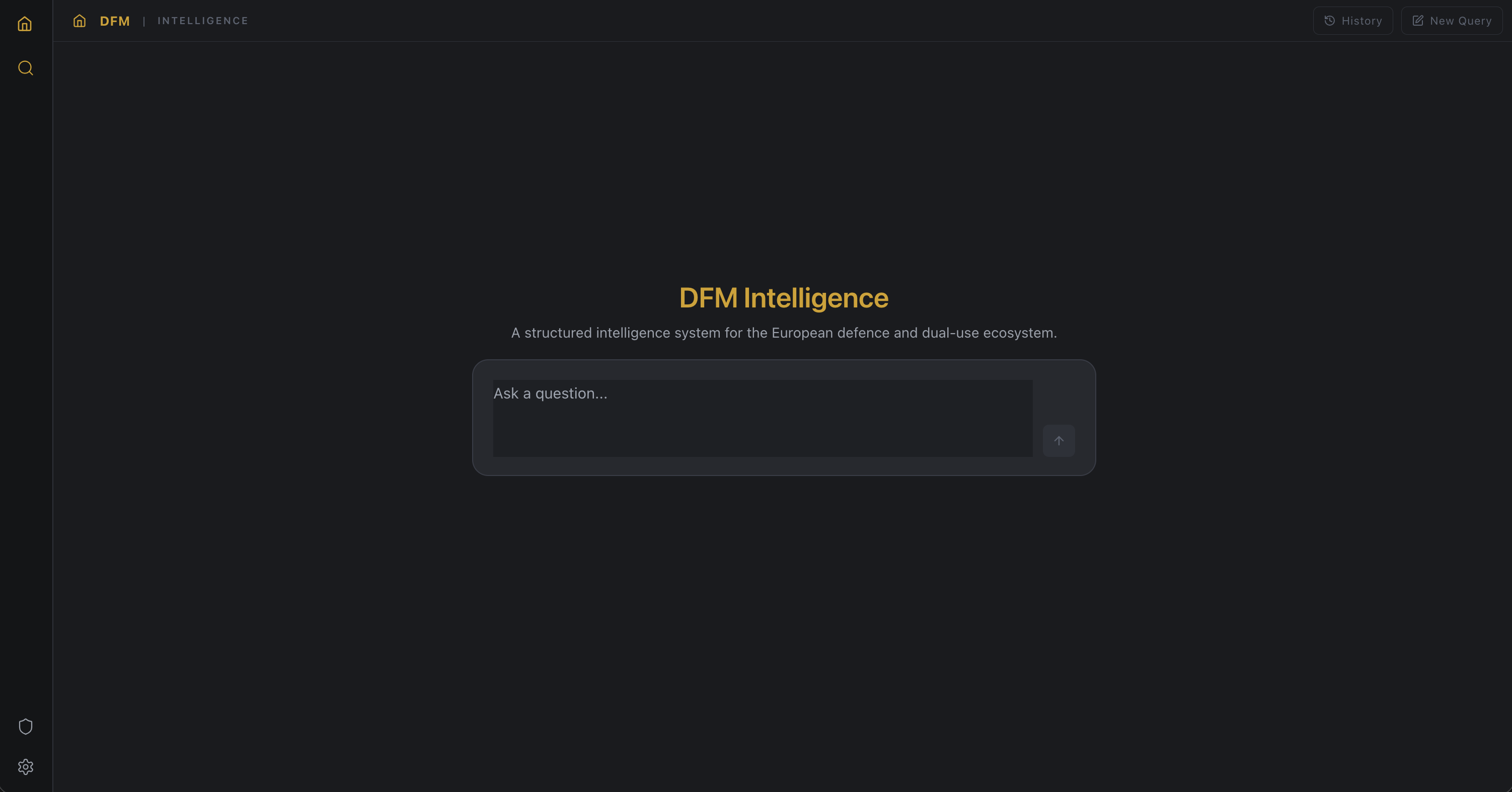
DFM Intelligence is the analytical platform that operates alongside the strategic and industrial analysis work of Defence Finance Monitor. It is a closed-ontology research engine — not a chatbot, not an aggregator — built on a structured knowledge graph of 1,915 verified European defence entities (companies, research institutes, investment funds, public institutions) connected through more than 138,000 typed relationships: supply-chain links, ownership chains, procurement contracts, co-programme participations and patent co-development. Every entity is classified against a proprietary vocabulary derived from NATO and EU strategic doctrine — 13 Strategic Priorities, 53 Operational Priorities and 52 Tactical Capabilities — alongside a separate industrial technology taxonomy of 18 domains, 108 sub-domains and 119 granular codes. The platform draws exclusively from certified institutional sources — TED procurement, CORDIS, GLEIF, EDF and EDIP beneficiary records, EPO patent data, EUR-Lex, national business registries across 25 jurisdictions, and OpenSanctions — together with the analytical research output produced by DFM over the past year. The resulting graph is currently exposed through a single surface — Live Query — designed to answer questions that would otherwise require weeks of manual cross-referencing. Two additional surfaces, the Knowledge Graph and Compare, are scheduled for release in the coming months.
The Query Layer
Live Query is the natural-language surface: given a question in plain English, the system returns a structured analytical response with citations to the specific entities and documents that support each claim. The mechanism combines two parallel retrieval paths — one that captures the meaning of the question (so “anti-drone systems” correctly reaches material indexed as “counter-UAS”), and one that catches exact names, regulation articles and contract identifiers. Both paths draw evidence exclusively from the certified data layer, never from the open web or generic AI knowledge, and only the retrieved evidence is passed to the language model that composes the answer. Each statement is pre-labelled as factual, probabilistic or interpretive, so verified evidence is always distinguishable from inference. Live Query currently handles ten question types: single-entity research, priority-to-company mapping, composite multi-criterion screening, regulatory due diligence, geographic and functional discovery, technology-to-company mapping, entity-versus-entity comparison, full sector mapping (up to 200 entities across nine analytical dimensions), multi-priority comparison, and capability gap discovery. Seven further types are scheduled in the coming months — programme coverage, geographic distribution, supply-chain tier mapping, multi-country and multi-regulation comparison, M&A activity tracking and dual-use crossover analysis.
DFM Intelligence is reserved for subscribers to the DFM annual programme.
For further information about DFM Intelligence, access conditions or payment by bank transfer, please contact: mastrolia@stroncature.com