

Defence Finance Monitor applies a top–down method that traces how NATO, EU and allied strategic priorities are translated into regulations, funding lines and procurement programmes, and then into demand for specific capabilities, technologies and companies. We use official doctrine as the organising frame to identify where strategic relevance is being institutionally defined and where it is materialising in concrete budgets, acquisition pathways and industrial capacity.
Our working assumption is that what becomes structurally relevant in NATO/EU strategy tends, over time, to become relevant also from a financial and industrial point of view. In the European context, this includes the progressive operationalisation of strategic autonomy: the effort to reduce critical dependencies, secure supply chains, strengthen the European defence technological and industrial base, and align regulatory, financial and procurement instruments with long-term security objectives. On this basis, DFM operates as a decision-support tool: it benchmarks investment and industrial choices against institutional demand, clarifies which capabilities are rising on the spending agenda, and maps the funding instruments, eligibility constraints and supply-chain factors that shape real-world feasibility across investors, industry, public authorities and research organisations.
Defence Finance Monitor rests on a single analytical premise: within the Euro-Atlantic security architecture, strategic doctrine precedes regulation and capability planning, regulation precedes budgets, and budgets shape markets.
European Security & Defence Industry · Strategic Intelligence
The European Long-Range Strike Industry: Supply Chains, Production Capacity and the Sovereignty Gap
Europe’s deep precision strike problem is no longer best understood as the absence of a single missile. The more accurate description is the absence of a system: effectors, propulsion, guidance sovereignty, energetic materials, test infrastructure, industrial scale and replenishment depth. The recent uncertainty surrounding US long-range deployments in Germany has made the vulnerability more visible, but it did not create it. Europe retains meaningful competence in air- and sea-launched strike, yet still lacks a fielded sovereign architecture in the politically salient 1,000–3,000 km range. The report addresses one central question: whether Europe can move from declared political ambition to industrialised production at scale, and where the binding constraints lie. It is structured in five parts. The first reconstructs the strategic and doctrinal frame that shaped European industrial posture after the INF Treaty. The second analyses the programme architecture across ELSA, the UK-Germany 2,000 km initiative, Tyrfing, Taurus Neo and the One Way Effector cluster. The third maps the industrial layer and identifies the sub-tier choke points where European sovereignty narrows. The fourth examines the financing and regulatory environment within which the long-range strike industry will have to operate. The fifth assesses comparative position, scenario trajectories and Italy’s specific positioning within the emerging European long-range strike ecosystem.
European Security & Defence Industry · Capability Intelligence
European AI Defence Sovereignty: From Foundation Models to Autonomous Defence Systems
European AI defence sovereignty is no longer a question of whether Europe can produce competitive foundation models. It is a question of whether Europe can connect compute, sovereign cloud, models, classified data, defence adaptation, sensors, platforms and operational governance into a coherent industrial chain. The emergence of Mistral, Helsing, Safran.AI, ICEYE, Quantum Systems, Tekever and other actors shows that Europe now has credible capabilities across most layers of the AI defence stack. The unresolved question is whether those capabilities will converge into a sovereign model-to-weapon architecture or remain a fragmented ecosystem of national champions. The report is structured as a six-layer mapping of the European AI defence supply chain. It begins with sovereign compute and cloud infrastructure, distinguishing what Europe controls from what still depends on external suppliers. It then examines the European foundation-model layer through Mistral, Aleph Alpha, LightOn and OpenEuroLLM. It moves to the defence adaptation and operational AI layer, with particular attention to Helsing’s evolution from software vendor into multi-domain integrator and to the model of incumbent-prime acquisition exemplified by Safran.AI. It then maps sensor, satellite, ISR and autonomous-platform integration through cases such as Rheinmetall–ICEYE, Quantum Systems and Tekever. The fifth part analyses the relationship between incumbent primes and defence-tech neo-primes through four observable integration models. The sixth assesses the emerging governance framework and the strategic conditions under which Europe could move from champions to a sovereign stack.
European Security & Defence Industry · Industrial Intelligence
Fincantieri–KAYO and the Build-with-Allied-Country Model: Albania as a European Defence-Industrial Test Case
The Fincantieri–KAYO joint venture signed in Tirana on 29 April 2026 exposes a strategic tension at the edge of Europe’s defence-industrial architecture. Albania is not an EU Member State, but it is a NATO ally and an EU candidate country, and now hosts a naval-industrial platform majority-controlled by one of Europe’s principal shipbuilding primes. The case matters because it suggests that European defence-industrial expansion may increasingly move through allied neighbouring territories that are strategically inside Europe’s security perimeter while remaining only conditionally connected to the Union’s legal framework. The report addresses one central question: whether the venture marks the emergence of a genuinely new build-with-allied-country model, distinct from export, offset and conventional localisation, or whether it remains an exceptional bilateral arrangement. It is structured to keep three levels rigorously separate. The first reconstructs the documented industrial baseline of the agreement, including KAYO’s role as a state-controlled Albanian defence vehicle, the Pashaliman shipyard and the under-80-metre export perimeter. The second develops the analytical reading across three planes — industrial-strategic, regional-Adriatic, legal — and assesses whether the case represents a genuinely new model. The third examines the implications for corporate actors, investors, regulatory advisers and sovereign decision-makers. The fourth identifies the signals to monitor over the next twelve months that will determine whether the model remains exceptional or becomes a replicable form of European defence-industrial projection.
Defence Finance Monitor · Platform Intelligence
DFM Intelligence. Structured Intelligence System for the European Defence and Dual-Use Ecosystem
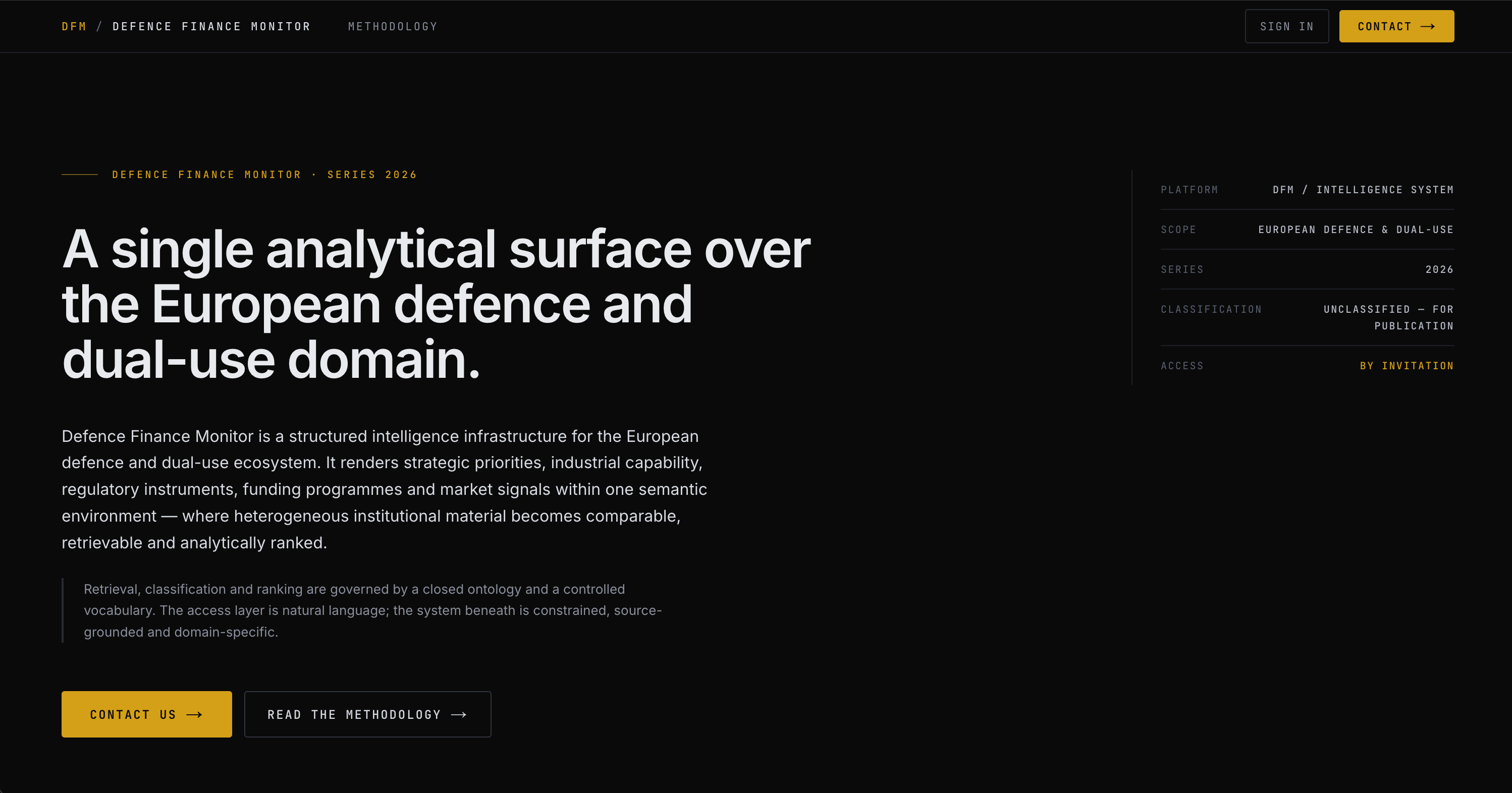
DFM Intelligence is not a news monitoring service and does not track headlines. It is a structured intelligence infrastructure designed to answer a different kind of question: which companies and technologies are strategically relevant to the EU’s defence imperatives, where does industrial capacity align or fall short of regulatory and procurement perimeters, and how do strategic priorities translate into eligibility conditions, funding channels and ownership exposure. The system is governed by a closed ontology covering Strategic Priorities, Operational Priorities, Tactical Capabilities and technology clusters, and its knowledge base currently includes 2,246 classified entities, 159,308 structured relations, 1,336 normative documents and 26,284 export-control licences — all decomposed and linked before any question is asked. The access layer is a natural-language interface called Live Query; the system beneath is constrained, domain-specific and source-grounded, built to observe the translation from EU and NATO doctrine to regulation, from regulation to industrial eligibility and procurement, and from capability gaps to the companies and technologies that sit inside or outside the EU’s strategic autonomy perimeter. DFM Intelligence is reserved for annual subscribers to Defence Finance Monitor, who receive access both to DFM Analysis and to the structured intelligence platform.
For further information about DFM Intelligence, access conditions or payment by bank transfer, please contact: mastrolia@stroncature.com