

Defence Finance Monitor applies a top–down method that traces how NATO, EU and allied strategic priorities are translated into regulations, funding lines and procurement programmes, and then into demand for specific capabilities, technologies and companies. We use official doctrine as the organising frame to identify where strategic relevance is being institutionally defined and where it is materialising in concrete budgets, acquisition pathways and industrial capacity.
Our working assumption is that what becomes structurally relevant in NATO/EU strategy tends, over time, to become relevant also from a financial and industrial point of view. In the European context, this includes the progressive operationalisation of strategic autonomy: the effort to reduce critical dependencies, secure supply chains, strengthen the European defence technological and industrial base, and align regulatory, financial and procurement instruments with long-term security objectives. On this basis, DFM operates as a decision-support tool: it benchmarks investment and industrial choices against institutional demand, clarifies which capabilities are rising on the spending agenda, and maps the funding instruments, eligibility constraints and supply-chain factors that shape real-world feasibility across investors, industry, public authorities and research organisations.
Defence Finance Monitor rests on a single analytical premise: within the Euro-Atlantic security architecture, strategic doctrine precedes regulation and capability planning, regulation precedes budgets, and budgets shape markets.
European Security & Space Industry · Industrial Intelligence
The Airbus-Leonardo-Thales Space Combination. Merger Control, Strategic Autonomy and the Future Structure of Europe’s Space Industrial Base
The proposed combination of the space activities of Airbus, Leonardo and Thales is not only a corporate transaction. It is a test of whether Europe can create industrial scale in a sovereignty-sensitive sector without weakening competition, procurement contestability and technological redundancy. The new entity — projecting approximately €6.5 billion in pro-forma 2024 revenues, 25,000 employees, and a backlog exceeding three years of projected sales, under a 35/32.5/32.5 ownership structure with joint control — would consolidate virtually all significant European prime satellite manufacturing and secure-communications capabilities, including the existing Thales Alenia Space and Telespazio joint ventures. The report examines the transaction across four layers: the precise perimeter of the assets contributed and the governance logic of the three-way joint control; the EU merger-control test under Regulation 139/2004, including relevant markets, horizontal overlaps, the Leonardo-Thales coordination dimension and the question of whether sovereignty arguments have any traction in a SIEC analysis; the national FDI and golden-power screening frameworks in Italy, France and Germany, the IRIS² and EU Space Programme implications, and the post-EDIP industrial-policy context; and the strategic consequences to 2030, from the European champion scenario to the risks of market concentration, governance deadlock and single-point-of-failure dependency.
European Security & Defence Industry · Regulatory Intelligence
European Propulsion Sovereignty under EDIP. The 35% Buy European Rule, the Pratt & Whitney Bottleneck and the Limits of Defence-Industrial Autonomy
Airbus’s Q1 2026 disclosure that Pratt & Whitney remains the key pacing factor in the A320 Family ramp-up — affecting delivery trajectories through 2027 — is a commercial aerospace event with a wider defence-industrial reading. Engine supply chains do not separate cleanly along civil-military lines, and the bottleneck reveals something precise: Europe holds major propulsion competence but limited propulsion sovereignty, measured not by the existence of engineering expertise but by control over design authority, hot-section manufacturing, FADEC software, export-control exposure and long-cycle capital commitment. The report uses the Pratt & Whitney case as an empirical entry point, then locates the EDIP 35% third-country component rule in the correct provision of Regulation (EU) 2025/2643 — Article 10(3), not Article 22 — and assesses what the rule captures and what it structurally leaves outside its accounting. From that regulatory baseline, the analysis moves through EDF 2026 propulsion topics, FCAS/NGF and EUMET, GCAP and Edgewing, EJ200 and Eurofighter sustainment, and the EIB financing constraints that apply to engine-adjacent industrial investment, closing with a DFM propulsion-sovereignty matrix for monitoring companies, programmes and technology nodes through 2035.
Defence Finance Monitor · Platform Intelligence
DFM Intelligence. Structured Intelligence System for the European Defence and Dual-Use Ecosystem
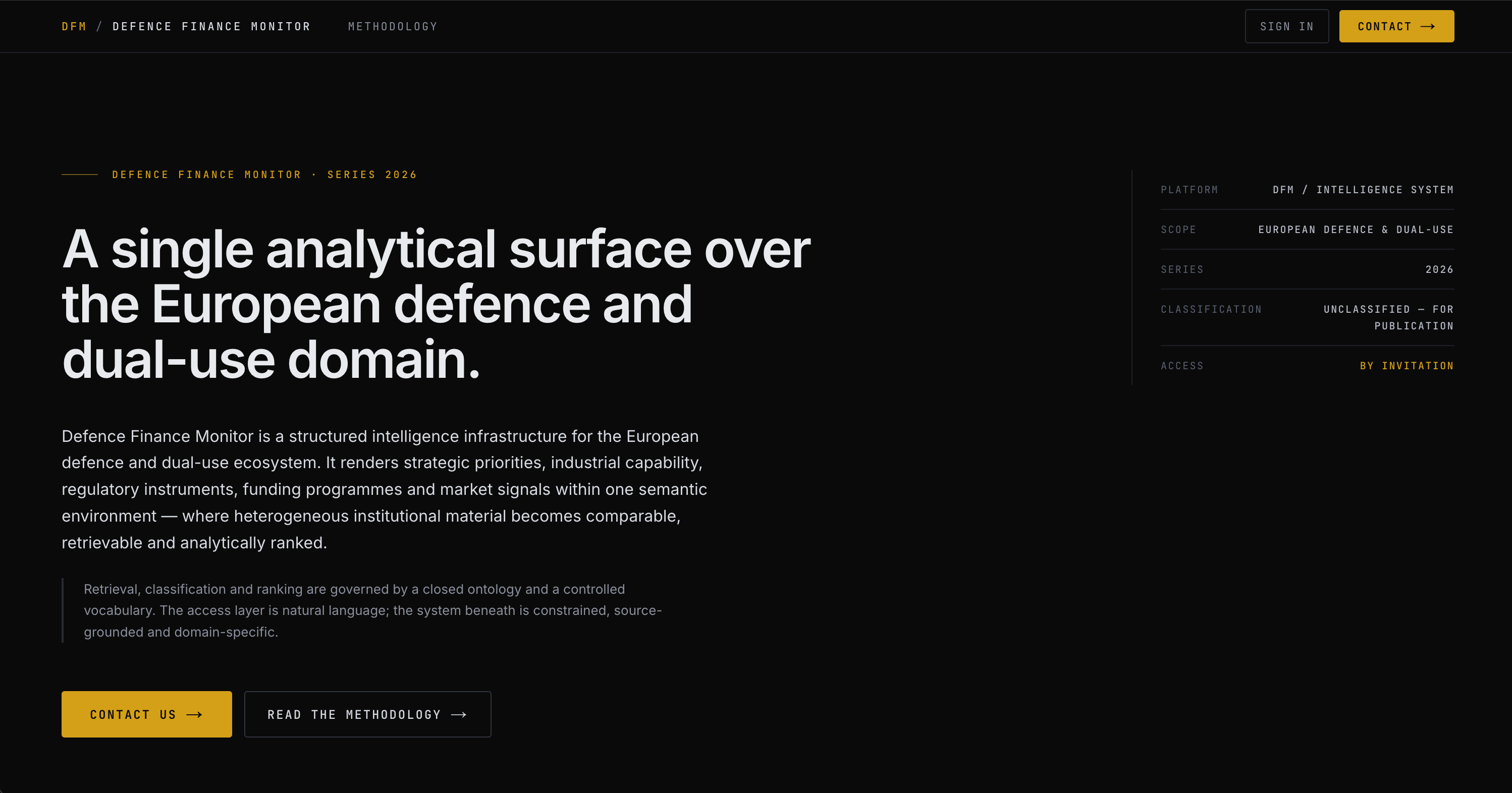
DFM Intelligence is not a news monitoring service and does not track headlines. It is a structured intelligence infrastructure designed to answer a different kind of question: which companies and technologies are strategically relevant to the EU’s defence imperatives, where does industrial capacity align or fall short of regulatory and procurement perimeters, and how do strategic priorities translate into eligibility conditions, funding channels and ownership exposure. The system is governed by a closed ontology covering Strategic Priorities, Operational Priorities, Tactical Capabilities and technology clusters, and its knowledge base currently includes 2,246 classified entities, 159,308 structured relations, 1,336 normative documents and 26,284 export-control licences — all decomposed and linked before any question is asked. The access layer is a natural-language interface called Live Query; the system beneath is constrained, domain-specific and source-grounded, built to observe the translation from EU and NATO doctrine to regulation, from regulation to industrial eligibility and procurement, and from capability gaps to the companies and technologies that sit inside or outside the EU’s strategic autonomy perimeter. DFM Intelligence is reserved for annual subscribers to Defence Finance Monitor, who receive access both to DFM Analysis and to the structured intelligence platform.
For further information about DFM Intelligence, access conditions or payment by bank transfer, please contact: mastrolia@stroncature.com