

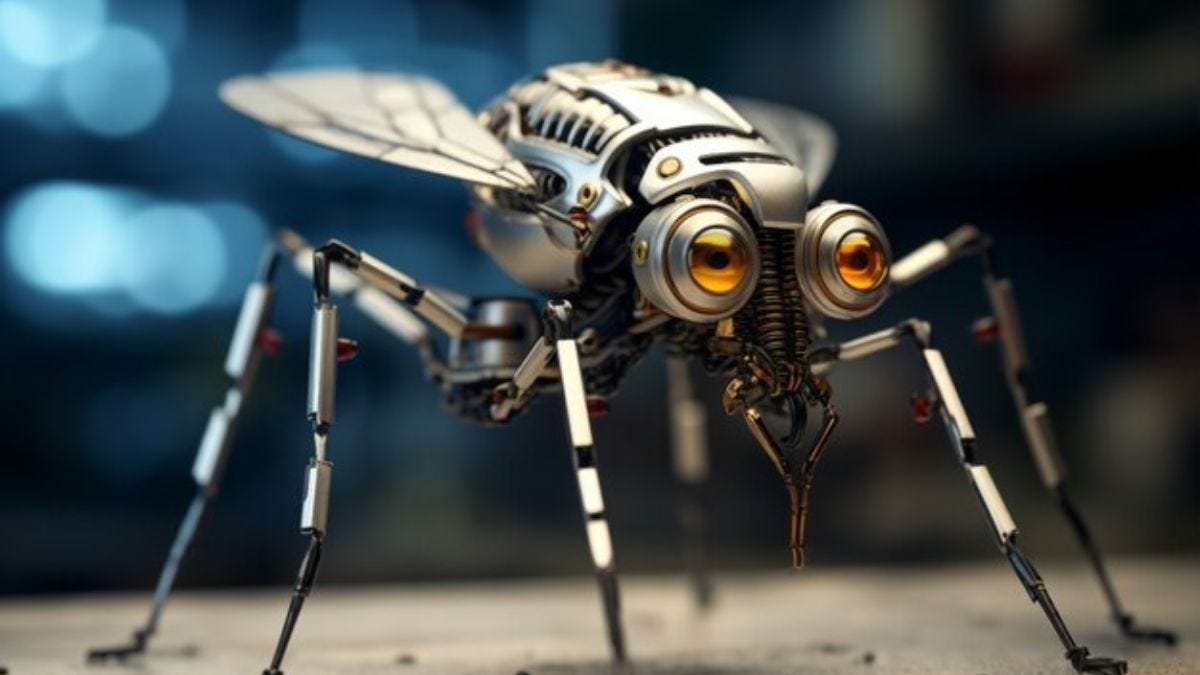
The unveiling of a mosquito-sized drone by China’s National University of Defense Technology has reignited the strategic debate on the military relevance of micro-unmanned aerial systems (UAS). Introduced through CCTV-7, the state’s military broadcaster, the device is the size of a fingernail and mimics the morphology of an insect, with thin legs and leaf-shaped wings. Such a design is optimized for close-proximity surveillance and covert indoor operations, suggesting a focus on tactical infiltration rather than strategic reconnaissance. The platform, however, remains more demonstrative of engineering prowess than battlefield applicability, raising questions on endurance, payload, and operational range.
Despite its technological novelty, the system's battlefield utility appears constrained by physics and current battery capabilities. Analysts such as Herb Lin (Stanford CISAC) and Samuel Bendett (CNA) emphasize that a drone of this scale is subject to critical limitations in stability, power, and communications. Air turbulence, even from air conditioning or open windows, can compromise navigation. Moreover, the miniature structure leaves limited room for sensors, processors, or antennas, all vital for autonomous or semi-autonomous operation. This calls into question whether the drone is ready for real-world deployment or remains in an experimental phase with narrow operational use-cases.
However, the strategic significance of such developments lies less in immediate performance and more in long-term trajectory. The drone is a clear signal of China’s sustained investment in shrinking the scale of military robotics and exploring the threshold of biological mimicry in ISR (intelligence, surveillance, reconnaissance). In doing so, it echoes a broader trend in modern warfare, where visibility, size and emissions become liabilities. While the West continues to optimize medium-to-large UAS with sophisticated payloads, China’s push in biomimetic micro-drones reflects a different strategic logic: gaining tactical advantage in confined environments, especially urban interiors and dense infrastructures.
Operationally, micro-drones such as this would not replace traditional surveillance assets but rather complement them in multi-layered intelligence ecosystems. For example, while MALE or HALE drones operate at higher altitudes for wide-area coverage, insect-sized drones could be deployed for close-target acquisition, signals interception, or reconnaissance in denied spaces. Their use could be particularly valuable in special operations, hostage rescue scenarios, or sabotage missions, where human presence is impractical or politically risky. The military relevance, therefore, hinges not on conventional warfighting, but on sub-threshold engagements and hybrid operations.
The broader implication is that warfare is evolving not only in scale, but in direction: from large-scale attrition to micro-scale penetration. The introduction of micro-drones into the Chinese arsenal marks a shift towards technologies designed for precision, stealth, and ambiguity. While limitations in energy density and environmental tolerance remain unresolved, the strategic intent is evident. Such platforms, if matured, could redefine tactical intelligence and introduce new vulnerabilities into secured environments. As the technology progresses, adversaries will be compelled to reassess the security of facilities, networks, and even personnel in proximity to what may appear as harmless insects.