

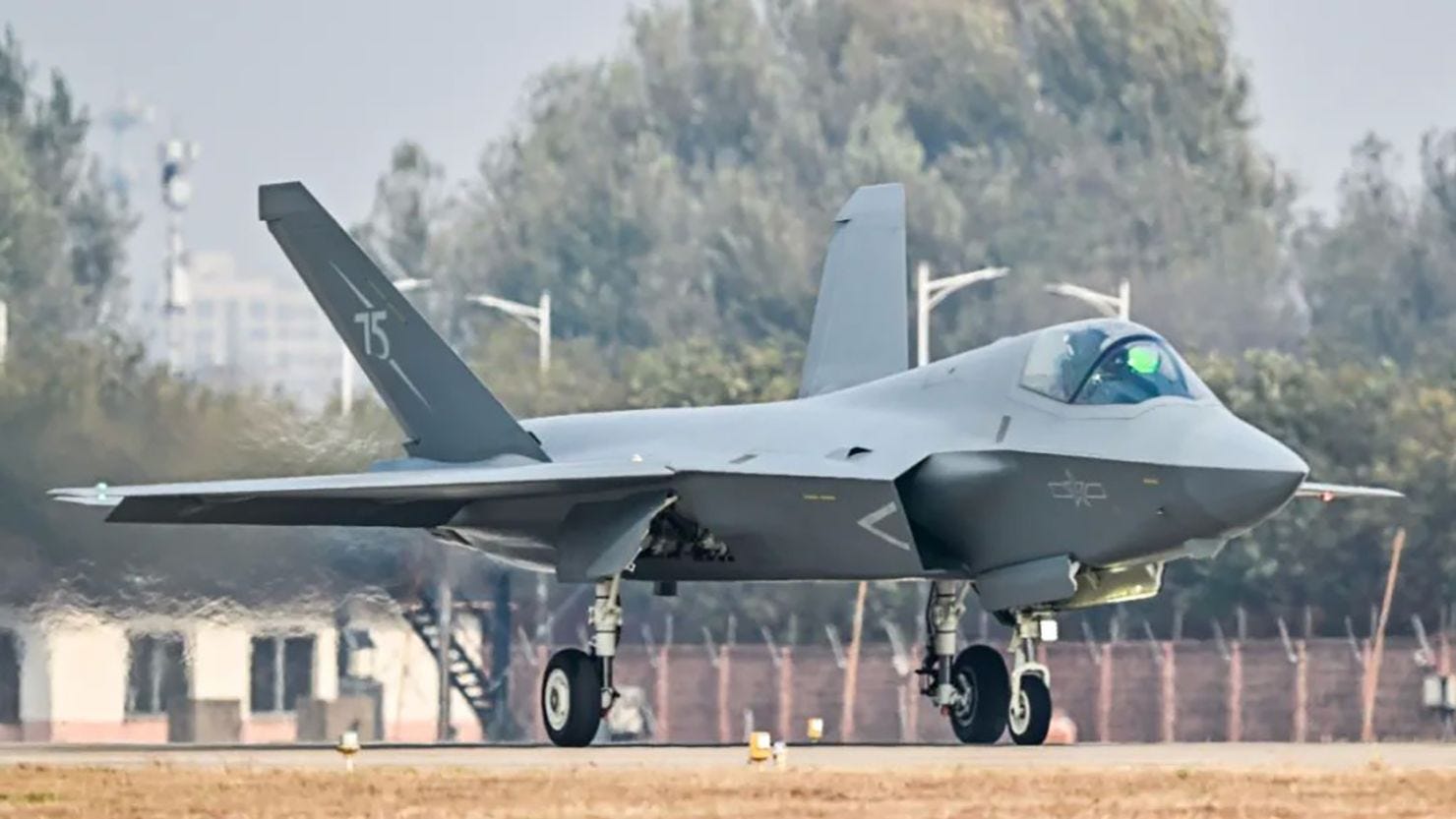
On July 8, 2025, China officially began serial production of the J-35A, the land-based variant of its fifth-generation stealth fighter developed by Shenyang Aircraft Corporation. Footage aired by CCTV 13 from the company’s production facility revealed multiple airframes in advanced stages of assembly, confirming that the program has transitioned beyond prototype status. This development positions China as the only nation besides the United States to field two operational fifth-generation fighter classes—the J-20 and J-35—within its air force.
The J-35A derives from the FC-31 demonstrator, featuring diverterless supersonic inlets, radar-absorbent materials, internal weapons bays, and advanced sensors including AESA radar and IRST. The aircraft is optimized for networked operations, electronic warfare resilience, and integration with other PLA platforms. It complements the heavier, longer-range J-20 by providing a more compact, cost-efficient solution suited for both air superiority and precision strike missions. The J-35A's service entry with the PLAAF’s 1st Air Brigade, a formation already operating the J-20, reflects a doctrinal shift toward flexible force structures based on stealth dispersion and combined-arms integration.
The aircraft’s physical characteristics suggest a medium-weight class with a length of approximately 17.3 meters and wingspan of 11.5 meters. Early production models are believed to be powered by WS-13E or WS-21 engines, with future variants potentially using the more powerful WS-19. Its internal payload capacity reportedly accommodates up to six air-to-air missiles, with external hardpoints available for additional ordnance. The avionics suite is expected to include helmet-mounted displays, electronic countermeasure systems, and wide-area cockpit interfaces. While some Western observers speculate about foreign technical inputs, official Chinese sources maintain that the J-35 is domestically developed under AVIC.
The strategic implications extend beyond national capabilities. The J-35A is being positioned for export, with a variant labeled J-35E reportedly under development. A model was displayed at the 2025 Paris Air Show, signaling interest in non-Western markets such as Egypt, Algeria, and Saudi Arabia—countries that have faced procurement restrictions from the U.S. and Europe. Although reports of a 40-aircraft offer to Pakistan remain unconfirmed, Chinese defense officials appear to be actively leveraging the J-35 as a diplomatic and industrial tool to reshape the global combat aircraft market.
The naval variant of the J-35 is undergoing parallel development for integration with China’s Type 003 aircraft carrier, Fujian, which employs electromagnetic catapults. Reports suggest successful carrier-based trials occurred in early 2025, with the Fujian projected to deploy up to 48 J-35s. Additional integration with the Liaoning, Shandong, and future platforms such as the Type 004 suggests the PLA Navy could operate close to 100 stealth carrier-based fighters by the early 2030s.
The dual deployment of J-20 and J-35A underscores a maturing Chinese aerospace strategy. The PLAAF’s tiered fighter force—comprising the J-10C, J-16, J-20, and J-35A—is designed to function across multiple operational domains. While U.S. analysts caution against equating the J-35’s capabilities with those of the F-35, the aircraft’s introduction marks a significant advancement in China’s aerospace industrial capacity and power projection potential. As both an operational asset and an export instrument, the J-35A exemplifies Beijing’s intent to reshape the technological and strategic balance in the global fighter aircraft market.