

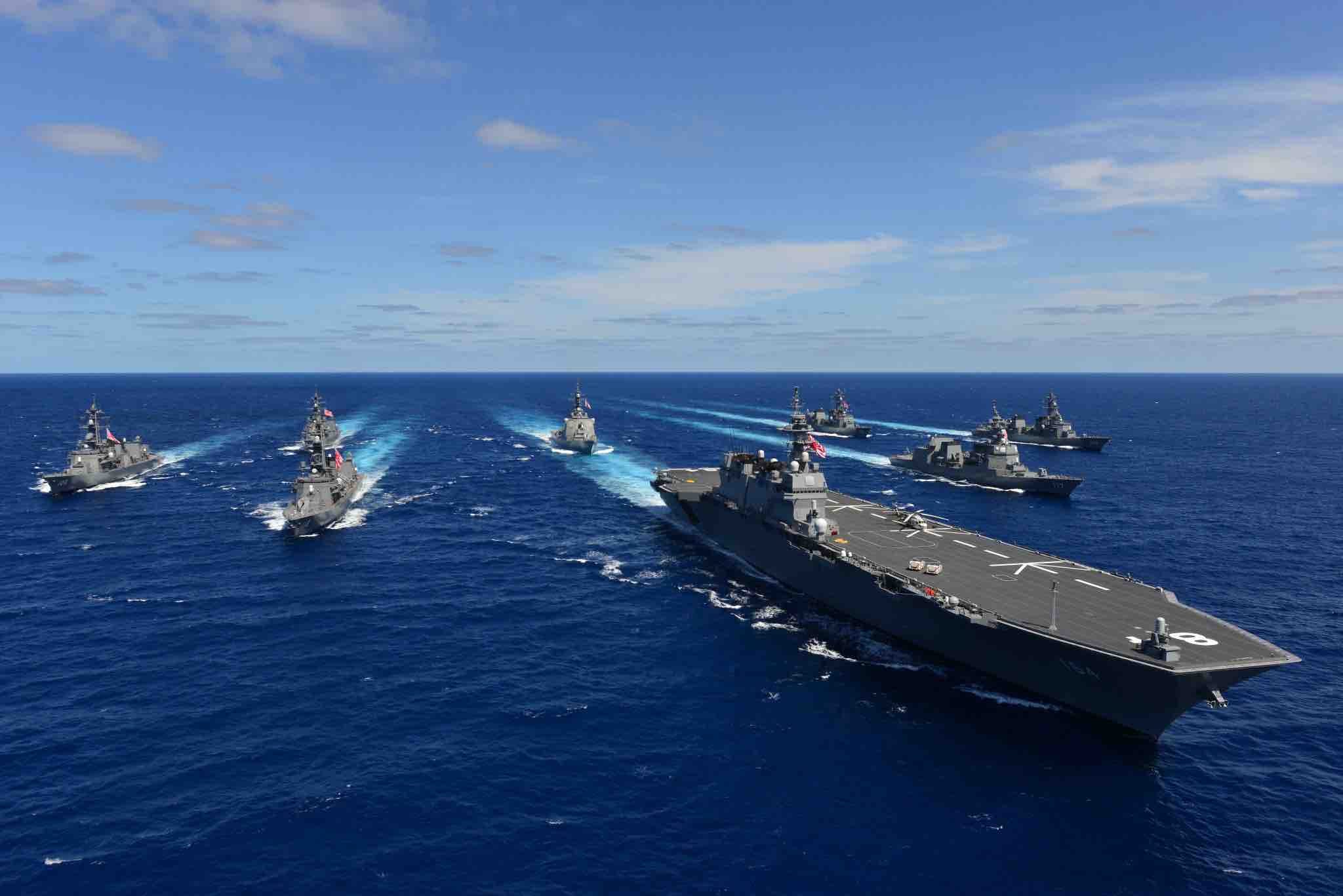
Geopolitical tensions in the Indo-Pacific – especially U.S.–China rivalry and North Korea’s provocations – have prompted a wave of defense rearmament among Asia-Pacific democracies. U.S. officials now openly push regional allies to boost military spending in order to deter China. At the Shangri-La defense forum in May 2025, U.S. Secretary of Defense Pete Hegseth warned that “the threat China poses is real, and it could be imminent,” and he urged Asian partners to “step up” their own defense budgets. Similarly, Washington’s review of the AUKUS security pact explicitly cites the need for allies to “step up fully to do their part for collective defense”. These signals echo the post‑Ukraine pattern in Europe, where U.S. pressure and a clear threat perception drove NATO members to sharply raise defense budgets (EU military spending rose to ~1.3% of GDP in 2023 and hit NATO’s 2% guideline in 2024). By analogy, U.S. strategy seems aimed at encouraging Japan, South Korea and Australia to likewise expand their defense outlays as a deterrent and burden‑sharing measure.
U.S. policymakers have begun explicitly lobbying key Asia‑Pacific allies on spending. In May 2025, Hegseth personally asked Australia to raise its defense spending, reportedly to around 3–3.5% of GDP. Prime Minister Albanese responded that Australia will increase spending to about 2.4% by the end of his term (up from about 2.2% in 2025) and that $50 billion has already been pledged over a decade. Japan and South Korea have likewise signaled major defense expansions. In late 2024 Japan announced its largest-ever budget (roughly $59 billion for FY2025) and reaffirmed a plan to double spending to 2% of GDP by 2027. North Korea’s missile tests and China’s military buildup have driven Seoul to propose its own record budget (about 61.6 trillion won, ~$46 billion, for 2025 – a 3.5% increase) aimed at beefing up air defenses and long-range strike systems. In short, a strategic “arms race” of democratic allies appears to be emerging – with Washington’s encouragement – paralleling Europe’s post‑Ukraine build-up.
In this context, investors might seek to capitalize on the secular uptick in Asia‑Pacific defense spending. This is the reason why Defence Finance Monitor proposes a thematic ETF that aggregates high‑float, defense‑exposed companies in South Korea, Japan and Australia, reflecting the expected growth in regional military budgets. The ETF’s ten holdings (with suggested weights) may be: Hanwha Aerospace (KR, 18%); Korea Aerospace Industries (KAI) (KR, 14%); LIG Nex1 (KR, 12%); Mitsubishi Heavy Industries (JP, 16%); Kawasaki Heavy Industries (JP, 10%); NEC Corporation (JP, 7%); Fujitsu (JP, 6%); EOS Defence Systems (Australia, 6%); BAE Systems Australia (ASC Pty) (via BAE Systems UK, 6%); and Thales Australia (via Thales Group, 5%). Each of these firms is a leading industrial contractor in its country with substantial defense revenues.
For example, Hanwha Aerospace (market cap ~$32 billion) is South Korea’s largest private aerospace and munitions manufacturer. KAI produces fighter jets and helicopters under license, and LIG Nex1 makes missile, radar and avionics systems. In Japan, Mitsubishi Heavy and Kawasaki Heavy build naval ships, submarines, fighter jets and missile launchers; NEC and Fujitsu supply C4ISR electronics, radar and computing systems for the Self-Defense Forces. Australia’s EOS Defence (publicly traded on ASX) is a leading builder of remote weapon stations, electro-optic sensors and counter-drone systems. ASC Pty is the Australian submarine yard (majority-owned by BAE Systems UK), and Thales Australia makes vehicle, gun and electronic systems for the Australian Army. Importantly these companies all have free-float investable shares (e.g. Hanwha Aerospace ~50% free float, LIG Nex1 ~54%, etc.), making them accessible to foreign ETFs.
Additional companies could be included in a secondary or expanded tranche of the ETF to enhance diversification and provide exposure to specific technological or operational niches. In Australia, firms such as Austal Ltd (ASX: ASB), a naval shipbuilder and supplier to both the U.S. and Australian navies, and DroneShield Ltd (ASX: DRO), a developer of AI-enabled counter-UAV systems with international defense contracts, offer complementary capabilities and direct exposure to rising demand for maritime and asymmetric warfare technologies. Codan Ltd (ASX: CDA), while not a pure defense company, is a relevant addition due to its production of military-grade communication systems. In South Korea, Hyundai Rotem—active in armored vehicle and train manufacturing—and Poongsan Corporation, a major supplier of ammunition and metal materials, are strong industrial candidates. Additionally, SNT Dynamics and SNT Motiv produce core defense components and systems with growing export footprints. In Japan, candidates such as IHI Corporation (naval and aerospace engines), Mitsui E&S Holdings (shipbuilding and marine defense), and smaller specialized firms like Namura Shipbuilding, Sumitomo Precision Products, and JAMCO Corp (aerospace systems) contribute to the domestic defense ecosystem and could be incorporated based on liquidity and relevance.
Taiwan-based companies could also be selectively included, provided a clear geostrategic rationale. While state-owned NCSIST (missile and radar development) is not listed, CSBC Corporation (TWSE: 2208), a naval shipbuilder supporting Taiwan’s indigenous submarine program, is publicly traded—albeit with low capitalization. Aerospace Industrial Development Corporation (AIDC), partially listed and involved in combat aircraft production, could also merit inclusion. While TSMC is not a defense company per se, its role in supplying semiconductors critical to defense electronics could justify a marginal allocation within a broader “strategic technologies” overlay. Lastly, a further extension of the ETF could include U.S. and European defense firms with deep industrial linkages or major contract exposure to Japan, South Korea, and Australia. This would allow the ETF to reflect the full transnational structure of Indo-Pacific defense integration, while maintaining its primary focus on liberal democracies confronting rising Chinese assertiveness.
This ETF design deliberately excludes Chinese companies and focuses exclusively on the most significant defense and aerospace industries operating within liberal democracies in East Asia and the Pacific that are formal allies of the United States. The sector tilt would be toward aerospace, shipbuilding and systems integrators; note that Japanese and Korean defense shares have already been strong performers (e.g. Hanwha Aerospace shares have more than doubled in 2024 amid global military demand). The proposed weightings balance larger firms (Mitsubishi Heavy 16%, Hanwha 18%) with smaller but fast-growing specialists (EOS and ASC each 6%). By contrast, existing global defense ETFs (such as VanEck’s DFND) currently underweight Asia (Hanwha Aerospace is only ~6–7% of DFND), leaving room for a dedicated Asia‑Pac fund.
By encapsulating these trends, the ETF offers investors a thematic way to ride a long‑term shift toward higher allied defense budgets. Its appeal would be strategic and secular rather than speculative – targeting regions (Taiwan strait, Korean peninsula, South China Sea) where deterrence demands enduring capability investments. Given clear government signals, the case is quantitative: Japan’s budget alone is set to double to nearly ¥10 trillion (~$70 billion) by 2027, and South Korea’s proposed budget tops 60 trillion won. Australia’s spending trajectory is accelerating (up ~9% in 2020 to $43 billion, with further rises expected as AUKUS execution proceeds). In aggregate, these allies will pour hundreds of billions into defense platforms and technology in coming years. An ETF with the above composition would capture a broad slice of that capital flow, drawing in everything from jet engines and guided munitions to command-and-control networks and submarines.
Major ETF issuers (VanEck, HANetf, WisdomTree, iShares, etc.) should note this emerging niche. A dedicated “Indo-Pacific Defense” or “Democratic Allies’ Defense” ETF – fully collateralized and rules‑based – could meet investor appetite for geographically targeted strategic exposure. Such a fund could leverage existing indexes or be custom‑built via partnerships with index providers, using the above weights as a template. Given the policy-driven nature of the trend, product marketing would emphasize not short‑term market timing but macro‑strategic mega‑themes: U.S. alliance burden‑sharing, rising China deterrence, and a new era of military modernization in allied Asia. In that sense, the ETF acts as an economic gambit matched to a geopolitical narrative – one where allied defense spending finally parallels perceived threats.
In conclusion, the confluence of U.S. diplomatic pressure and Asia’s security concerns makes higher defense budgets in Japan, South Korea and Australia a strategic certainty. That secular shift warrants a thematic investment vehicle. We recommend that ETF sponsors explore launching an Asia‑Pacific defense-focused equity fund along these lines. It would be a timely addition to the ETF landscape, offering investors formalized exposure to a defense spending upswing that is as much geopolitical policy as it is market trend.