

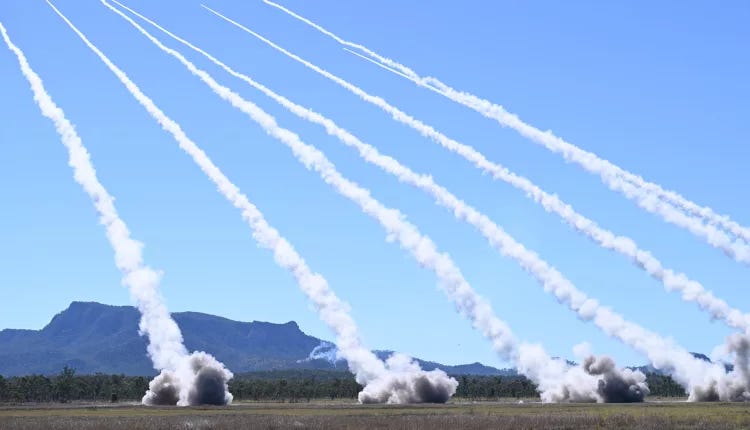
Australia has fired its first HIMARS (High Mobility Artillery Rocket System) during the opening day of the multinational "Talisman Sabre" military exercise, marking a turning point in the country’s integration of long-range strike capabilities. The joint firing, conducted in Queensland alongside U.S. and Singaporean forces, featured the truck-mounted launcher that has gained notoriety for its effectiveness in Ukraine and its strategic value in the Indo-Pacific. With a range of up to 400 kilometers, HIMARS represents a significant enhancement of Australia's military posture as the country shifts focus toward deterrence in response to China's growing assertiveness. The exercise brought together over 40,000 troops from 19 nations, underscoring the scale and complexity of regional security collaboration.
The live-fire event, overseen by senior Australian officials including Governor General Sam Mostyn and Defence Chief Admiral David Johnston, illustrates Australia’s intention to play a more assertive role in regional security. Brigadier Nick Wilson, director general of the live-fire exercise, noted that this was the first time HIMARS had been used by Australian forces on their own territory. He emphasized that the system will form part of a broader strategy of "denial"—a doctrine aimed at preventing adversaries from projecting force into key areas of interest. The firing was integrated with U.S. F-35B jets and other missile systems, showcasing a multi-domain approach to deterrence and joint operations.
Australia's HIMARS acquisition is part of a broader investment program aimed at increasing long-range strike capacity and logistical flexibility. Canberra has committed to spending A$74 billion (US$49 billion) on missiles over the next decade, including establishing domestic production lines to reduce reliance on foreign suppliers. The first two of 42 HIMARS launchers were delivered by Lockheed Martin earlier this year, and future units are expected to be rapidly deployable across Australia's northern perimeter and potentially into nearby island nations. This reflects a doctrinal shift toward mobility and forward basing, mirroring U.S. efforts in the Pacific to enhance responsiveness and deterrence.
The Talisman Sabre exercise functions not only as a show of military interoperability but also as a strategic message to adversaries. U.S. Lieutenant General Joel Vowell, deputy commanding general for the Pacific, described the exercise as "a deterrent mechanism," noting that the goal is not confrontation but stability. The ability of multiple allied forces to coordinate complex joint fires, including long-range precision strikes, reinforces deterrence by denial and raises the threshold for aggression. The involvement of Japan, France, and South Korea further highlights the emergence of a wider coalition of democracies aligning their defence postures in the face of shared challenges.
While HIMARS is at the forefront of the headlines, the broader story is one of regional military evolution and integration. The pace at which the system has been fielded in Australia, and the scale of cooperation demonstrated during Talisman Sabre, indicate a new phase of defence preparedness in the Indo-Pacific. With rising geopolitical tensions and increased pressure on supply chains and defence budgets, initiatives like this reflect both urgency and coordination. As Canberra moves to strengthen its capabilities, and partners like the U.S. deepen their regional ties, the Indo-Pacific is entering a new era of joint deterrence—firmly rooted in operational readiness and mutual strategic interests.
Source
Australia fires first HIMARS long-range rocket in war game with US